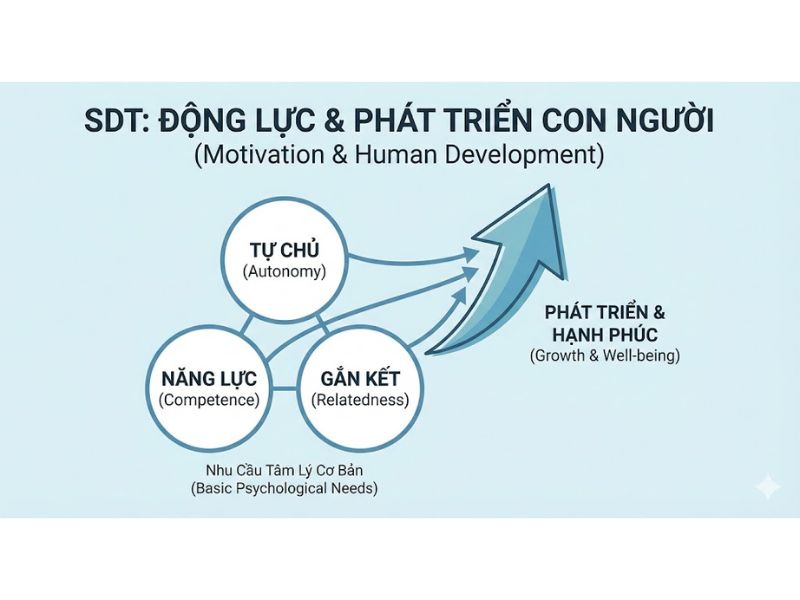
Thuyết Tự quyết (Self-Determination Theory – SDT) là một hệ thống lý thuyết tâm lý học vĩ mô giải thích động lực con người dựa trên mức độ tự chủ và sự thỏa mãn các nhu cầu tâm lý cơ bản, thay vì chỉ dựa vào các tác động bên ngoài (thưởng/phạt). Trong bối cảnh khoa học tiếp thị hiện đại, khi các mô hình hành vi truyền thống (như TRA, TPB) bộc lộ hạn chế trong việc giải thích các hành vi tự nguyện và cảm xúc, SDT nổi lên như một giải pháp tối ưu để giải mã “hộp đen” tâm lý người tiêu dùng thông qua ba nhu cầu cốt lõi: Tự chủ (Autonomy), Năng lực (Competence) và Gắn kết (Relatedness).
1. Tổng Quan & Cơ Sở Lý Thuyết (Overview & Theoretical Foundations)
1.1 Thông tin định danh công trình nghiên cứu
Bài viết này được xây dựng dựa trên việc phân tích và tổng hợp công trình nghiên cứu nền tảng sau:
- Tiêu đề gốc: The role of self-determination theory in marketing science: An integrative review and agenda for marketing research.
- Tiêu đề tiếng Việt: Vai trò của Thuyết Tự quyết trong Khoa học Tiếp thị: Một bài tổng quan tích hợp và chương trình nghị sự cho nghiên cứu tiếp thị.
- Tác giả: Faheem Gul Gilal, Zhang Jian, Justin Paul, Naeem Gul Gilal (2018).
- Tạp chí: European Management Journal.
1.2 Bối cảnh và Khoảng trống nghiên cứu
Trong nhiều thập kỷ, tư duy marketing bị chi phối bởi các lý thuyết hành vi truyền thống như:
- Lý thuyết Hành động Hợp lý (TRA) & Hành vi Có kế hoạch (TPB): Tập trung vào thái độ và chuẩn mực xã hội.
- Mô hình Hành vi Hướng mục tiêu (MGB): Tập trung vào mục tiêu và dự định.
Vấn đề: Các lý thuyết này chủ yếu dựa trên động lực ngoại lai (extrinsic focus) và giả định con người luôn hành động dựa trên tính toán lý trí. Chúng thất bại trong việc giải thích:
- Tại sao khách hàng vẫn mua sản phẩm đắt tiền mà không cần khuyến mãi?
- Tại sao người dùng gắn bó cảm xúc với thương hiệu (Brand Love)?
- Cơ chế tâm lý sâu xa của các hành vi tự nguyện (Autonomous behaviors).
Giải pháp: SDT lấp đầy khoảng trống này bằng cách chứng minh rằng động lực bền vững nhất xuất phát từ bên trong (nội tại), được nuôi dưỡng bởi môi trường xã hội hỗ trợ quyền tự quyết.
2. Hệ Thống 6 Tiểu Thuyết (Mini-Theories) Của SDT Trong Tiếp Thị
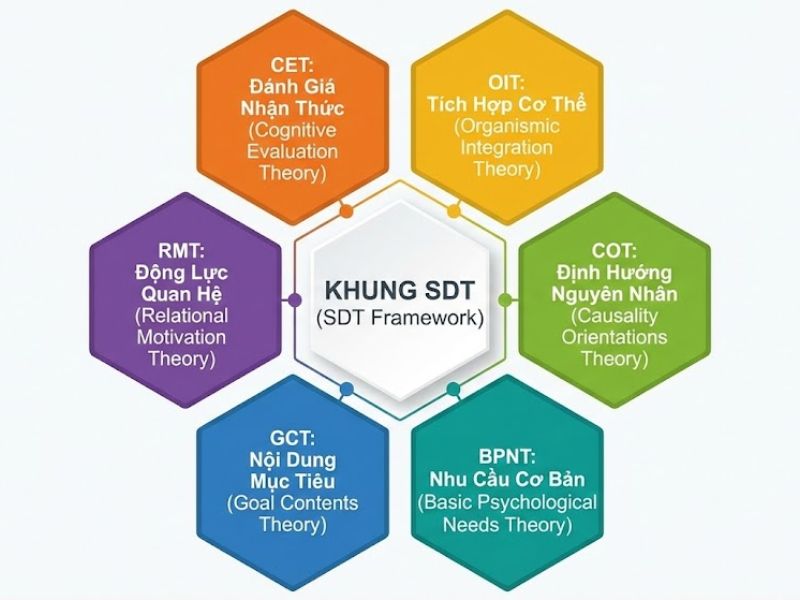
SDT không phải là một lý thuyết đơn lẻ mà là tập hợp của 6 tiểu thuyết, mỗi tiểu thuyết giải quyết một khía cạnh riêng biệt của động lực tiêu dùng:
2.1 Thuyết Đánh giá Nhận thức (Cognitive Evaluation Theory – CET)
- Nội dung: Giải thích các yếu tố xã hội (phần thưởng, deadline, phản hồi) ảnh hưởng thế nào đến động lực nội tại.
- Ứng dụng: Trong quảng cáo, việc nhấn mạnh quá mức vào phần thưởng vật chất có thể làm “xói mòn” hứng thú tự nhiên của khách hàng đối với sản phẩm.
2.2 Thuyết Tích hợp Hữu cơ (Organismic Integration Theory – OIT)
- Nội dung: Phân loại động lực ngoại lai thành 4 cấp độ dựa trên mức độ tự chủ hóa (internalization):
- Điều chỉnh bên ngoài (External): Mua vì sợ phạt/muốn thưởng.
- Điều chỉnh nội nhập (Introjected): Mua vì lòng tự trọng hoặc áp lực.
- Điều chỉnh xác định (Identified): Mua vì thấy giá trị cá nhân.
- Điều chỉnh tích hợp (Integrated): Hành vi hòa hợp hoàn toàn với bản ngã (dạng cao nhất).
- Ứng dụng: Chuyển đổi khách hàng từ mua vì “khuyến mãi” (External) sang mua vì “giá trị thực” (Integrated).
2.3 Thuyết Định hướng Nhân quả (Causality Orientations Theory – COT)
- Nội dung: Phân loại tính cách khách hàng thành 3 nhóm:
- Định hướng tự chủ: Thích tự ra quyết định.
- Định hướng bị kiểm soát: Thích được chỉ dẫn, tuân thủ.
- Định hướng phi động lực: Cảm thấy bất lực, phó mặc.
2.4 Thuyết Nhu cầu Tâm lý Cơ bản (Basic Psychological Needs Theory – BPNT)
- Nội dung: Con người có 3 nhu cầu bẩm sinh cần được thỏa mãn để đạt trạng thái tâm lý tốt nhất:
- Tự chủ (Autonomy): Cảm giác được làm chủ hành vi.
- Năng lực (Competence): Cảm giác hiệu quả, giỏi giang.
- Gắn kết (Relatedness): Cảm giác thuộc về, được quan tâm.
2.5 Thuyết Nội dung Mục tiêu (Goal Contents Theory – GCT)
- Nội dung: Phân biệt mục tiêu sống Nội tại (phát triển bản thân, cộng đồng) và Ngoại lai (giàu có, danh tiếng).
- Ứng dụng: Giải thích hành vi tiêu dùng hàng xa xỉ (ngoại lai) so với tiêu dùng xanh/bền vững (nội tại).
2.6 Thuyết Động lực Mối quan hệ (Relationships Motivation Theory – RMT)
- Nội dung: Tập trung vào chất lượng các mối quan hệ. Một mối quan hệ tốt (giữa khách hàng và thương hiệu) phải thỏa mãn nhu cầu Gắn kết.
3. Tổng Hợp Các Nghiên Cứu Điển Hình (Structured Data)
Dựa trên dữ liệu từ 49 nghiên cứu thực nghiệm (1998-2018), bảng dưới đây tóm tắt các phát hiện quan trọng nhất để các nhà nghiên cứu tiện tra cứu:
| Lý thuyết (Theory) | Tác giả & Năm | Bối cảnh Nghiên cứu | Kết quả Nghiên cứu Cốt lõi (Key Findings) |
| CET | Teo, Lim, & Lai (1999) | Sử dụng Internet | Người dùng Internet chủ yếu bị thúc đẩy bởi động lực ngoại lai (tính hữu dụng) hơn là niềm vui nội tại. |
| Shang, Chen, & Shen (2005) | Mua sắm Online | Ngược lại, động lực nội tại (niềm vui mua sắm) là yếu tố chính giữ chân người mua online, không phải giá rẻ. | |
| Truong & McColl (2011) | Hàng xa xỉ | Động lực nội tại có tác động tiêu cực đến hành vi tiêu dùng phô trương. Người coi trọng giá trị bên trong ít mua đồ hiệu để khoe khoang. | |
| OIT | Morse & Peloso (2003) | Hành vi | Sinh viên có động lực xác định (thấy giá trị tương lai) sẽ kiên trì hơn nhóm chỉ hành động vì phần thưởng. |
| Lin, Tsai, & Chiu (2009) | Lòng trung thành | Lòng trung thành bền vững chỉ được tạo ra bởi động lực nội tại & xác định. Động lực bị kiểm soát (ép buộc/thưởng) không hiệu quả lâu dài. | |
| COT | Dholakia (2006) | Khuyến mãi (Coupons) | Phiếu giảm giá nhắc nhở (Reminder coupons) làm giảm động lực của nhóm khách hàng có định hướng tự chủ cao (họ cảm thấy bị làm phiền). |
| Webb et al. (2013) | Tiết kiệm năng lượng | Động lực tự chủ dự báo hành vi tốt hơn bất kỳ biến số nào của các mô hình truyền thống (như TPB). | |
| BPNT | Thomson (2006) | Thương hiệu con người | Khi người nổi tiếng giúp fan thỏa mãn nhu cầu Tự chủ và Gắn kết, sự gắn bó cảm xúc sẽ gia tăng mạnh mẽ. |
| Jillapalli & Wilcox (2010) | Giáo dục | Giáo sư thỏa mãn nhu cầu sinh viên sẽ tạo ra lòng tin và sự ủng hộ (Advocacy) như một đại sứ thương hiệu. | |
| GCT | Truong et al. (2010) | Thương hiệu xa xỉ | Lựa chọn hàng hiệu chịu ảnh hưởng lớn bởi mục tiêu ngoại lai (danh vọng) và bị ảnh hưởng tiêu cực bởi mục tiêu nội tại. |
4. Chương Trình Nghị Sự Cho Nghiên Cứu Tương Lai (Future Research Agenda)
Bài báo đề xuất 6 Mệnh đề (Propositions) quan trọng để định hướng các nghiên cứu tiếp theo:
- Mệnh đề 1a & 1b (CET Focus): Nghiên cứu sâu hơn về sự tương tác giữa Động lực nội tại với các yếu tố hấp dẫn của quảng cáo (ví dụ: quảng cáo cảm xúc, hoài niệm). Giả thuyết là động lực nội tại sẽ phản ứng mạnh hơn với các yếu tố này so với động lực ngoại lai.
- Mệnh đề 2 (BPNT Focus): Sử dụng 3 nhu cầu (Tự chủ, Năng lực, Gắn kết) làm Biến trung gian (Mediators) để giải thích cơ chế tác động của chiến thuật marketing lên hành vi người tiêu dùng (Tại sao thiết kế đẹp lại dẫn đến mua hàng? => Vì nó thỏa mãn nhu cầu Năng lực).
- Mệnh đề 3 (OIT Focus): Kiểm chứng rằng các Điều chỉnh động lực tự chủ (Nội tại, Xác định) có tác động tích cực và bền vững hơn đến kết quả tiếp thị (như WOM, lòng trung thành) so với các Điều chỉnh bị kiểm soát.
- Mệnh đề 4 (RMT Focus): Khám phá xem các yếu tố doanh số và tiêu dùng ảnh hưởng thế nào đến Nhu cầu gắn kết. Đây là mảng chưa được nghiên cứu (n=0).
- Mệnh đề 5 (COT Focus): Nghiên cứu sự tương tác giữa Định hướng nhân quả của khách hàng (Tự chủ vs Bị kiểm soát) với các chiến thuật bán hàng (Hard-sell vs Soft-sell).
- Mệnh đề 6 (GCT Focus): Xem xét cách Mục tiêu cuộc sống (Người duy vật vs Người hướng nội) điều tiết mối quan hệ giữa sản phẩm và sự hài lòng.
5. Ứng Dụng Quản Trị Doanh Nghiệp (Managerial Implications)
Đây là phần quan trọng nhất đối với các nhà thực hành marketing, được đúc kết từ các kết quả thực nghiệm của SDT:
5.1 Chiến lược Cá nhân hóa Khuyến mãi (Dựa trên COT & Dholakia, 2006)
Doanh nghiệp cần phân đoạn khách hàng dựa trên Định hướng nhân quả (Causality Orientation):
- Đối với khách hàng “Tự chủ” (Thường là khách hàng trung thành, hiểu biết): Hạn chế gửi các email nhắc nhở dồn dập hoặc coupon mang tính thúc ép. Việc này làm họ cảm thấy mất quyền kiểm soát và giảm động lực mua hàng. Hãy tiếp cận họ bằng thông tin giá trị và để họ tự quyết định.
- Đối với khách hàng “Bị kiểm soát” (Thường là khách hàng mới, thụ động): Các chiến thuật nhắc nhở, tạo sự khan hiếm (Scarcity) hoặc giảm giá trực tiếp sẽ hiệu quả hơn để kích thích hành vi.
5.2 Xây dựng Thương hiệu Gắn kết (Dựa trên BPNT & Thomson, 2006)
Để tạo ra sự gắn bó cảm xúc (Emotional Attachment) thay vì chỉ là quan hệ giao dịch:
- Thỏa mãn nhu cầu Gắn kết (Relatedness): Thương hiệu cần đóng vai trò như một người bạn, biết lắng nghe và thấu hiểu. Sử dụng Influencer marketing không chỉ để quảng bá tính năng mà để kể những câu chuyện tạo sự đồng cảm, giúp khách hàng cảm thấy họ thuộc về một cộng đồng cùng giá trị.
- Thỏa mãn nhu cầu Tự chủ (Autonomy): Tránh các thông điệp quảng cáo mang tính áp đặt (“Bạn phải mua”). Hãy dùng thông điệp trao quyền (“Lựa chọn là của bạn”, “Khám phá theo cách của bạn”).
5.3 Thiết kế Sản phẩm và Dịch vụ (Dựa trên BPNT)
Sản phẩm không chỉ cần tốt mà còn phải giúp khách hàng cảm thấy “giỏi”:
- Nâng cao Năng lực (Competence): Thiết kế giao diện người dùng (UI/UX) trực quan, dễ sử dụng. Cung cấp các hướng dẫn (Tutorials), mẹo vặt giúp khách hàng sử dụng sản phẩm hiệu quả nhất. Khi khách hàng cảm thấy mình làm chủ được sản phẩm, họ sẽ hài lòng hơn.
- Trao quyền Tùy biến: Cho phép khách hàng tùy chỉnh sản phẩm (Customization) theo sở thích cá nhân. Điều này thỏa mãn nhu cầu Tự chủ tối đa.
5.4 Chiến lược Quảng cáo cho từng dòng sản phẩm (Dựa trên GCT)
- Hàng Xa xỉ (Luxury Goods): Tập trung vào các thông điệp Ngoại lai (Địa vị, sự ngưỡng mộ, hình ảnh hào nhoáng) vì đây là động lực chính của nhóm khách hàng này.
- Sản phẩm Xanh/Bền vững: Tuyệt đối tránh các thông điệp khoe khoang. Hãy tập trung vào các mục tiêu Nội tại (Sự an tâm, đóng góp cho cộng đồng, phát triển nhận thức).
5.5 Quản trị Nhân sự Tuyến đầu (Frontline Employees)
- Nhân viên bán hàng cần được đào tạo để hỗ trợ quyền tự chủ của khách hàng (Autonomy Support). Thay vì ép khách mua, nhân viên nên cung cấp thông tin, lắng nghe nhu cầu và đưa ra các lựa chọn để khách hàng tự quyết định. Điều này tạo ra sự tin tưởng (Trust) và mối quan hệ dài hạn (Jillapalli & Wilcox, 2010).
6. Các Câu Hỏi Thường Gặp (FAQ)
SDT khác biệt gì lớn nhất so với Tháp nhu cầu Maslow trong ứng dụng marketing?
SDT không phân cấp nhu cầu theo thứ bậc (phải đủ ăn mới cần tự trọng). SDT khẳng định 3 nhu cầu (Tự chủ, Năng lực, Gắn kết) là nhu cầu tâm lý cốt lõi cần thiết ở mọi lúc, mọi nơi để duy trì động lực bền vững. Trong marketing, bạn có thể thỏa mãn cả 3 nhu cầu này cùng lúc trong một chiến dịch.
Làm sao để đo lường “Động lực nội tại” của khách hàng?
Các nhà nghiên cứu thường dùng thang đo “Chỉ số Động lực Tự chủ” (Relative Autonomy Index – RAI). Trong thực tế doanh nghiệp, bạn có thể đo lường thông qua các chỉ số hành vi tự nguyện như: tỷ lệ giới thiệu không cần thưởng (Organic referral), thời gian tương tác với nội dung phi khuyến mãi, hoặc các phản hồi tích cực về giá trị thương hiệu.
Doanh nghiệp có nên bỏ hoàn toàn các chương trình giảm giá (động lực ngoại lai) không?
Không. Động lực ngoại lai vẫn hữu ích trong giai đoạn đầu để thu hút khách hàng (Acquisition). Tuy nhiên, SDT khuyên rằng doanh nghiệp cần có lộ trình chuyển đổi (Internalization): Dùng khuyến mãi để khách hàng dùng thử, sau đó dùng chất lượng và trải nghiệm để giữ chân họ bằng động lực nội tại.
7. Tài Liệu Tham Khảo (References)
(Danh sách trích dẫn giữ nguyên ngôn ngữ gốc theo chuẩn APA để đảm bảo tính chính xác học thuật)
Acebrón, L. B., & Dopico, D. C. (2000). The importance of intrinsic and extrinsic cues to expected and experienced quality: an empirical application for beef. Food Quality and Preference, 11(3), 229-238.
Ajzen, I. (1985). From intentions to actions: A theory of planned behavior (pp. 11-39). Springer Berlin Heidelberg.
Albers-Miller, N. D., & Royne Stafford, M. (1999). An international analysis of emotional and rational appeals in services vs goods advertising. Journal of Consumer Marketing, 16(1), 42-57.
Bagozzi, R. P. (1982). A field investigation of causal relations among cognitions, affect, intentions, and behavior. Journal of Marketing Research, 562-583.
Bagozzi, R. P., & Warshaw, P. R. (1990). Trying to consume. Journal of Consumer Research, 17(2), 127-140.
Bagozzi, R. P., Wong, N., Abe, S., & Bergami, M. (2000). Cultural and situational contingencies and the theory of reasoned action: Application to fast food restaurant consumption. Journal of Consumer Psychology, 9(2), 97-106.
Batra, R., Ahuvia, A., & Bagozzi, R. P. (2012). Brand love. Journal of Marketing, 76(2), 1-16.
Baumeister, R. F., & Leary, M. R. (1995). The need to belong: desire for interpersonal attachments as a fundamental human motivation. Psychological Bulletin, 117(3), 497-529.
Baumgartner, H., & Pieters, R. (2003). The structural influence of marketing journals: A citation analysis of the discipline and its subareas over time. Journal of Marketing, 67(2), 123-139.
Bhagat, P. S., & Williams, J. D. (2002). Leveraging relationships in marketing: a motivational perspective. Journal of Relationship Marketing, 1(3-4), 39-67.
Binney, W., Kennedy, W., & Hall, J. (2004, January). Self-determination theory and needs satisfaction in marketing education: are we meeting the needs of students in large marketing classes?. In ANZMAC 2004: Marketing accountabilities and responsibilities: Proceedings of the 2004 Austrn and New Zealand Marketing Academy conference (pp. 1-9). School of Marketing and International Business, Vicktoria University of Wellington.
Birtwistle, G., & Tsim, C. (2005). Consumer purchasing behaviour: an investigation of the UK mature women’s clothing market. Journal of Consumer Behaviour, 4(6), 453-464.
Biswas, A., & Roy, M. (2016). A Study of Consumers’ Willingness to Pay for Green Products. Journal of Advanced Management Science, 4(3), 211-215.
Black, A. E., & Deci, E. L. (2000). The effects of instructors’ autonomy support and students’ autonomous motivation on learning organic chemistry: A self-determination theory perspective. Science Education, 84(6), 740-756.
Bojei, J., Julian, C. C., Wel, C. A. B. C., & Ahmed, Z. U. (2013). The empirical link between relationship marketing tools and consumer retention in retail marketing. Journal of Consumer Behaviour, 12(3), 171-181.
Botti, S., & McGill, A. L. (2011). The locus of choice: Personal causality and satisfaction with hedonic and utilitarian decisions. Journal of Consumer Research, 37(6), 1065-1078.
Cadwallader, S., Jarvis, C. B., Bitner, M. J., & Ostrom, A. L. (2010). Frontline employee motivation to participate in service innovation implementation. Journal of the Academy of Marketing Science, 38(2), 219-239.
Carrigan, M. (1998). Segmenting the grey market: the case for fifty-plus “lifegroups”. Journal of Marketing Practice: Applied Marketing Science, 4(2), 43-56.
Carroll, B. A., & Ahuvia, A. C. (2006). Some antecedents and outcomes of brand love. Marketing Letters, 17(2), 79-89.
Chang, C. T., & Tung, M. H. (2016). Intergenerational appeal in advertising: impacts of brand-gender extension and brand history. International Journal of Advertising, 35(2), 345-361.
Chatterjee, P., & Kumar, A. (2017). Consumer willingness to pay across retail channels. Journal of Retailing and Consumer Services, 34, 264-270.
Chen, Y. C., Chang, J. S., & Gong, Y. T. (2015). A content analysis of infant and toddler food advertisements in Taiwanese popular pregnancy and early parenting magazines. Journal of Human Lactation, 31(3), 458-466.
Deci, E. L. (1975). Intrinsic motivation. New York and London.
Deci, E. L., & Ryan, R. M. (1985a). The general causality orientations scale: Self-determination in personality. Journal of Research in Personality, 19(2), 109-134.
Deci, E. L., & Ryan, R. M. (1985b). Intrinsic motivation and self-determination in human behavior. New York: Plenum.
Deci, E. L., & Ryan, R. M. (2000). The” what” and” why” of goal pursuits: Human needs and the self-determination of behavior. Psychological Inquiry, 11(4), 227-268.
Deci, E. L., & Ryan, R. M. (2002). Overview of self-determination theory: An organismic dialectical perspective. Handbook of Self-determination Research, 3-33.
Deci, E. L., Connell, J. P., & Ryan, R. M. (1989). Self-determination in a work organization. Journal of Applied Psychology, 74(4), 580-590.
Dholakia, U. M. (2006). How customer self-determination influences relational marketing outcomes: evidence from longitudinal field studies. Journal of Marketing Research, 43(1), 109-120.
Diallo, M. F., Coutelle-Brillet, P., Rivière, A., & Zielke, S. (2015). How do price perceptions of different brand types affect shopping value and store loyalty?. Psychology & Marketing, 32(12), 1133-1147.
Engel, J. F., Kollat, D. T., & Blackwell, R. D. (1968). A model of consumer motivation and behavior. Research in Consumer Behavior, Holt, Rinehart and Winston, Inc., New York, NY, 3-20.
Engström, J., & Elg, M. (2015). A self-determination theory perspective on customer participation in service development. Journal of Services Marketing, 29(6/7), 511-521.
Erasmus, A. C., Boshoff, E., & Rousseau, G. G. (2001). Consumer decision-making models within the discipline of consumer science: a critical approach. Journal of Consumer Sciences, 29(1), 82-90.
Erfgen, C., Sattler, H., & Villeda, I. V. (2016). Effects of celebrity endorsers for multiple brands on attitudes and purchase intentions. Schmalenbach Business Review, 17(1), 49-67.
Fishbein, M., & Ajzen, I. (1975). Beleif, attitude, intention and behavior: An introduction to theory and research. Reading, MA: Addison-Wesley.
Francis, S., & Burns, L. D. (1992). Effect of consumer socialization on clothing shopping attitudes, clothing acquisition, and clothing satisfaction. Clothing and Textiles Research Journal, 10(4), 35-39.
Gentry, L., & Calantone, R. (2002). A comparison of three models to explain shop-bot use on the web. Psychology & Marketing, 19(11), 945-956.
Ghobadian, A., & O’Regan, N. (2011). Building from scratch a marketing services giant by acquisition: Case study and interview with Sir Martin Sorrell, Chief Executive of WPP. Journal of Strategy and Management, 4(3), 289-300.
Gilal, F. G., Zhang, J., Gilal, N. G., & Gilal, R. G. (2018). Association between a parent’s brand passion and a child’s brand passion: a moderated moderated-mediation model. Psychology Research and Behavior Management, 11, 91-102.
Gilal, F. G., Zhang, J., Gilal, N. G., & Gilal, R. G. (2018). Integrating self-determined needs into the relationship among product design, willingness-to-pay a premium, and word-of-mouth: a cross-cultural gender-specific study. Psychology Research and Behavior Management, 11, 227-241.
Gilal, F. G., Zhang, J., Gilal, R. G., & Gilal, N. G. (2018). Linking motivational regulation to brand passion in a moderated model of customer gender and age: an organismic integration theory perspective. Review of Managerial Science.
Gilal, F. G., Zhang, J., Gilal, R. G., & Gilal, N. G. (2018). Integrating intrinsic motivation into the relationship between product design and brand attachment: a cross-cultural investigation based on self-determination theory. European Journal of International Management.
Gilal, N. G., Zhang, J., & Gilal, F. G. (2018). Linking product design to consumer behavior: the moderating role of consumption experience. Psychology Research and Behavior Management, 11, 169-185.
Gilal, N. G., Zhang, J., & Gilal, F. G. (2018). The Four-Factor Model of Product Design: Scale Development and Validation. Journal of Product & Brand Management.
Gilal, F. G., Zhang, J., Gilal, N. G., & Gilal, R. G. (2018). Linking Self-determined Needs and Word of Mouth to Consumer E-waste Disposal Behaviour: A Test of Basic Psychological Needs Theory. Journal of Consumer Behaviour.
Gong, T., Choi, J. N., & Murdy, S. (2016). Does customer value creation behavior drive customer well-being?. Social Behavior and Personality: An International Journal, 44(1), 59-75.
Gountas, J., Gountas, S., Reeves, R. A., & Moran, L. (2012). Desire for fame: scale development and association with personal goals and aspirations. Psychology & Marketing, 29(9), 680-689.
Grisaffe, D. B., & Nguyen, H. P. (2011). Antecedents of emotional attachment to brands. Journal of Business Research, 64(10), 1052-1059.
Hagger, M. S., & Chatzisarantis, N. L. (2009). Integrating the theory of planned behaviour and self-determination theory in health behaviour: A meta-analysis. British Journal of Health Psychology, 14(2), 275-302.
Hagger, M. S., Chatzisarantis, N. L. D., & Biddle, S. J. H. (2002b). A meta-analytic review of the theories of reasoned action and planned behavior in physical activity: Predictive validity and the contribution of additional variables. Journal of Sport and Exercise Psychology, 24, 3-32.
Herzog, W., Morhart, F., & Reinecke, S. (2007). Shaping the functional significance of loyalty rewards and its effect on self-determined customer motivation. Marketing Theory and Applications, 312-313.
Hofstede, G. (1980). Culture’s consequences: International differences in work-related values Sage Publications. Beverly Hills, CA.
Howard, J. A., & Sheth, J. N. (1969). The theory of buyer behavior (Vol. 14). New York: Wiley.
Hung, H. Y., & Lu, H. T (2018). The rosy side and the blue side of emotional brand attachment. Journal of Consumer Behaviour.
Hsieh, S. H., & Chang, A. (2016). The psychological mechanism of brand co-creation engagement. Journal of Interactive Marketing, 33, 13-26.
Huang, Y. C., Backman, K. F., Backman, S. J., & Chang, L. L. (2016). Exploring the implications of virtual reality technology in tourism marketing: An integrated research framework. International Journal of Tourism Research, 18(2), 116-128.
Hudson, S., Roth, M. S., Madden, T. J., & Hudson, R. (2015). The effects of social media on emotions, brand relationship quality, and word of mouth: An empirical study of music festival attendees. Tourism Management, 47, 68-76.
Ilicic, J., Baxter, S. M., & Kulczynski, A. (2016). The impact of age on consumer attachment to celebrities and endorsed brand attachment. Journal of Brand Management, 23(3), 273-288.
Japutra, A., Ekinci, Y., & Simkin, L. (2014). Exploring brand attachment, its determinants and outcomes. Journal of Strategic Marketing, 22(7), 616-630.
Jillapalli, R. K., & Wilcox, J. B. (2010). Professor brand advocacy: Do brand relationships matter?. Journal of Marketing Education, 32(3), 328-340.
Joshanloo, M. (2016). Religiosity moderates the relationship between negative affect and life relationship satisfaction: A study in 29 European countries. Journal of Research in Personality, 61, 11-14.
Kasser, T. (2002). Sketches for a self-determination theory of values. Handbook of Self-determination Research, 123-140.
Kasser, T., & Ryan, R. M. (1996). Further examining the American dream: Differential correlates of intrinsic and extrinsic goals. Personality and Social Psychology Bulletin, 22(3), 280-287.
Kim, E., & Drumwright, M. (2016). Engaging consumers and building relationships in social media: How social relatedness influences intrinsic vs. extrinsic consumer motivation. Computers in Human Behavior, 63, 970-979.
Knee, C. R., Lonsbary, C., Canevello, A., & Patrick, H. (2005). Self-determination and conflict in romantic relationships. Journal of Personality and Social Psychology, 89, 997-1009.
Koestner, R., Losier, G. F., Vallerand, R. J., & Carducci, D. (1996). Identified and introjected forms of political internalization: extending self-determination theory. Journal of Personality and Social Psychology, 70(5), 1025-1036.
Kozlenkova, I. V., Samaha, S. A., & Palmatier, R. W. (2014). Resource-based theory in marketing. Journal of the Academy of Marketing Science, 42(1), 1-21.
Kumar, A., & Paul, J. (2018). Mass prestige value and competition between American versus Asian laptop brands in an emerging market-Theory and evidence. International Business Review.
Leone, L., Perugini, M., & Ercolani, A. P. (2004). Studying, practicing, and mastering: A test of the model of goal-directed behavior (MGB) in the software learning domain. Journal of Applied Social Psychology, 34(9), 1945-1973.
Leung, L. S. K., & Matanda, M. J. (2013). The impact of basic human needs on the use of retailing self-service technologies: A study of self-determination theory. Journal of Retailing and Consumer Services, 20(6), 549-559.
Leavell, J. P. (2017). Controlling and Informational Planned Behavior: Self-Determination Theory and the Theory of Planned Behavior. Atlantic Marketing Journal, 5(3), 81-91.
Levy, S., & Hino, H. (2016). Emotional brand attachment: a factor in customer-bank relationships. International Journal of Bank Marketing, 34(2), 136-150.
Li, J., Ngai, E. W. T., & Xu, X. (2015). Is a Positive Review Always Effective? Advertising Appeal Effect in the Persuasion of Online Customer Reviews. In PACIS (p. 164).
Ligas, M., & Chaudhuri, A. (2012). The moderating roles of shopper experience and store type on the relationship between perceived merchandise value and willingness to pay a higher price. Journal of Retailing and Consumer Services, 19(2), 249-258.
Lin, C. P., Tsai, Y. H., & Chiu, C. K. (2009). Modeling customer loyalty from an integrative perspective of self-determination theory and expectation-confirmation theory. Journal of Business and Psychology, 24(3), 315-326.
Loroz, P. S., & Braig, B. M. (2015). Consumer Attachments to Human Brands: The “Oprah Effect”. Psychology & Marketing, 32(7), 751-763.
Madden-Hallett, H., Hall, J., & Binney, W. (2006). The creation of effective learners using an autarchic study method. International Journal of Learning, 12, 1-8.
Malhotra, Y. (2004). Desperately seeking self-determination: key to the new enterprise logic of customer relationships. AMCIS 2004 Proceedings, 3895-3901.
Mandrik, C. A., Fern, E. F., & Bao, Y. (2005). Intergenerational influence: Roles of conformity to peers and communication effectiveness. Psychology & Marketing, 22(10), 813-832.
Hassan Fathelrahman Mansour, I., & Mohammed Elzubier Diab, D. (2016). The relationship between celebrities’ credibility and advertising effectiveness: The mediation role of religiosity. Journal of Islamic Marketing, 7(2), 148-166.
Martin, K. D., & Hill, R. P. (2012). Life satisfaction, self-determination, and consumption adequacy at the bottom of the pyramid. Journal of Consumer Research, 38(6), 1155-1168.
McGinnis, L. P., Gentry, J. W., & Gao, T. (2008). The impact of flow and communitas on enduring involvement in extended service encounters. Journal of Service Research, 11(1), 74-90.
Meyer-Waarden, L. (2013). The impact of reward personalisation on frequent flyer programmes’ perceived value and loyalty. Journal of Services Marketing, 27(3), 183-194.
Mishra, A. S., Roy, S., & Bailey, A. A. (2015). Exploring brand personality-celebrity endorser personality congruence in celebrity endorsements in the Indian context. Psychology & Marketing, 32(12), 1158-1174.
Mishra, S., & Muralie, S. (2007). Thinking Beyond Mass Media: Changing Trends in Marketing Communication. Journal of Marketing & Communication, 3(2), 76-85.
Moller, A. C., Ryan, R. M., & Deci, E. L. (2006). Self-determination theory and public policy: Improving the quality of consumer decisions without using coercion. Journal of Public Policy & Marketing, 25(1), 104-116.
Elizabeth S. Moore, William L. Wilkie, and Julie A. Alder (2001), “Lighting the Torch: How Do Intergenerational Influences Develop?”, in NA – Advances in Consumer Research Volume 28.
Morse, A., & Peloso, A. (2003). A Self-Determination Approach to Understanding the Protection and Attainment of Delayed, High Cost Goals.
Moussa, S., & Touzani, M. (2010). Ranking marketing journals using the Google Scholar-based hg-index. Journal of Informetrics, 4(1), 107-117.
Norris, J. I., & Williams, C. E. (2016). What do we really need? Goals and values, security, and the perception of consumer necessity. Psychology & Marketing, 33(2), 73-81.
Okazaki, S., Mueller, B., & Taylor, C. R. (2010). Measuring soft-sell versus hard-sell advertising appeals. Journal of Advertising, 39(2), 5-20.
Otero-López, J. M., & Villardefrancos, E. (2015). Compulsive buying and life aspirations: An analysis of intrinsic and extrinsic goals. Personality and Individual Differences, 76, 166-170.
Pacheco, B. G., & Rahman, A. (2015). Effects of sales promotion type and promotion depth on consumer perceptions: the moderating role of retailer reputation. The International Review of Retail, Distribution and Consumer Research, 25(1), 72-86.
Palmatier, R. W., Houston, M. B., & Hulland, J. (2018). Review articles: purpose, process, and structure. Journal of the Academy of Marketing Science.
Palmatier, R. W. (2016). Improving publishing success at JAMS: contribution and positioning. Journal of the Academy of Marketing Science.
Palmatier, R. W., Jarvis, C. B., Bechkoff, J. R., & Kardes, F. R. (2009). The role of customer gratitude in relationship marketing. Journal of Marketing, 73(5), 1-18.
Palmatier, R. W., Scheer, L. K., Evans, K. R., & Arnold, T. J. (2008). Achieving relationship marketing effectiveness in business-to-business exchanges. Journal of the Academy of Marketing Science, 36(2), 174-190.
Palmatier, R. W., Dant, R. P., Grewal, D., & Evans, K. R. (2006). Factors influencing the effectiveness of relationship marketing: A meta-analysis. Journal of Marketing, 70(4), 136-153.
Park, D. H., Lee, J., & Han, I. (2007). The effect of on-line consumer reviews on consumer purchasing intention: The moderating role of involvement. International Journal of Electronic Commerce, 11(4), 125-148.
Paul, J. (2015). Masstige marketing redefined and mapped: Introducing a pyramid model and MMS measure. Marketing Intelligence & Planning, 33(5), 691-706.
Paul, J. (2018). Masstige Model and Measure for Brand Management. European Management Journal.
Paul, J., Parthasarathy, S., & Gupta, P. (2017). Exporting challenges of SMEs: A review and future research agenda. Journal of World Business, 52(3), 327-342.
Paul, J., & Benito, G. R. (2018). A review of research on outward foreign direct investment from emerging countries, including China: what do we know, how do we know and where should we be heading?. Asia Pacific Business Review, 24(1), 90-115.
Perugini, M., & Bagozzi, R. P. (2001). The role of desires and anticipated emotions in goal-directed behaviours: Broadening and deepening the theory of planned behaviour. British Journal of Social Psychology, 40(1), 79-98.
Pleshko, L. P., & Heiens, R. A. (2015). Customer satisfaction and loyalty in the Kuwaiti retail services market: why are satisfied buyers not always loyal buyers?. The International Review of Retail, Distribution and Consumer Research, 25(1), 55-71.
Preston, I. L. (1968). Relationships among emotional, intellectual, and rational appeals in advertising.
Proksch, M., Orth, U. R., & Cornwell, T. B. (2015). Competence enhancement and anticipated emotion as motivational drivers of brand attachment. Psychology & Marketing, 32(9), 934-949.
Ramsøy, T. Z., & Skov, M. (2014). Brand preference affects the threshold for perceptual awareness. Journal of Consumer Behaviour, 13(1), 1-8.
Rana, J., & Paul, J. (2017). Consumer behavior and purchase intention for organic food: A review and research agenda. Journal of Retailing and Consumer Services, 38, 157-165.
Razmus, W., Jaroszyńska, M., & Palęga, M. (2017). Personal aspirations and brand engagement in self-concept. Personality and Individual Differences, 105, 294-299.
Rifon, N. J., Jiang, M., & Kim, S. (2016). Don’t Hate me Because I am Beautiful: Identifying the Relative Influence of Celebrity Attractiveness and Character Traits on Credibility. In Advances in Advertising Research.
Rotter, J. B. (1966). Generalized expectancies for internal versus external control of reinforcement. Psychological Monographs: General and Applied, 80(1), 1-28.
Russo, I., Confente, I., Gligor, D. M., & Autry, C. W. (2016). To be or not to be (loyal): Is there a recipe for customer loyalty in the B2B context?. Journal of Business Research, 69(2), 888-896.
Ryan, R. M., & Deci, E. L. (2000). Self-determination theory and the facilitation of intrinsic motivation, social development, and well-being. American Psychologist, 55(1), 68-78.
Ryan, R. M., Rigby, C. S., & Przybylski, A. (2006). The motivational pull of video games: A self-determination theory approach. Motivation and Emotion, 30(4), 344-360.
Schepers, J., Falk, T., Ruyter, K. D., Jong, A. D., & Hammerschmidt, M. (2012). Principles and principals: do customer stewardship and agency control compete or complement when shaping frontline employee behavior?. Journal of Marketing, 76(6), 1-20.
Schindler, R. M., & Bickart, B. (2012). Perceived helpfulness of online consumer reviews: The role of message content and style. Journal of Consumer Behaviour, 11(3), 234-243.
Shang, R. A., Chen, Y. C., & Shen, L. (2005). Extrinsic versus intrinsic motivations for consumers to shop on-line. Information & Management, 42(3), 401-413.
Sharma, S., Conduit, J., & Rao Hill, S. (2017). Hedonic and eudaimonic well-being outcomes from co-creation roles: a study of vulnerable customers. Journal of Services Marketing, 31(4/5), 397-411.
Sicilia, M., Delgado-Ballester, E., & Palazon, M. (2016). The need to belong and self-disclosure in positive word-of-mouth behaviours: The moderating effect of self-brand connection. Journal of Consumer Behaviour, 15(1), 60-71.
Sørebø, Ø., Halvari, H., Gulli, V. F., & Kristiansen, R. (2009). The role of self-determination theory in explaining teachers’ motivation to continue to use e-learning technology. Computers & Education, 53(4), 1177-1187.
Steenkamp, J. B. E., Van Heerde, H. J., & Geyskens, I. (2010). What makes consumers willing to pay a price premium for national brands over private labels?. Journal of Marketing Research, 47(6), 1011-1024.
Strutton, D., Taylor, D. G., & Thompson, K. (2011). Investigating generational differences in e-WOM behaviours: for advertising purposes, does X= Y?. International Journal of Advertising, 30(4), 559-586.
Sun, T., Tai, Z., & Tsai, K. C. (2010). Perceived ease of use in prior e-commerce experiences: A hierarchical model for its motivational antecedents. Psychology & Marketing, 27(9), 874-886.
Sweeney, J. C., Webb, D., Mazzarol, T., & Soutar, G. N. (2014). Self-Determination Theory and Word of Mouth about Energy-Saving Behaviors: An Online Experiment. Psychology & Marketing, 31(9), 698-716.
Tang, Q., Zhao, X., & Liu, S. (2016). The effect of intrinsic and extrinsic motivations on mobile coupon sharing in social network sites: the role of coupon proneness. Internet Research, 26(1), 101-119.
Teo, T. S., Lim, V. K., & Lai, R. Y. (1999). Intrinsic and extrinsic motivation in internet usage. Omega, 27(1), 25-37.
Thomas, A. B. (2004). Research skills for management studies. Psychology Press.
Thompson, S. A., & Sinha, R. K. (2008). Brand communities and new product adoption: The influence and limits of oppositional loyalty. Journal of Marketing, 72(6), 65-80.
Thomson, M. (2006). Human brands: Investigating antecedents to consumers’ strong attachments to celebrities. Journal of Marketing, 70(3), 104-119.
Truong, Y., & McColl, R. (2011). Intrinsic motivations, self-esteem, and luxury goods consumption. Journal of Retailing and Consumer Services, 18(6), 555-561.
Truong, Y., McColl, R., & Kitchen, P. J. (2010). Uncovering the relationships between aspirations and luxury brand preference. Journal of Product & Brand Management, 19(5), 346-355.
Vansteenkiste, M., Niemiec, C. P., & Soenens, B. (2010). The development of the five mini-theories of self-determination theory: An historical overview, emerging trends, and future directions. In The decade ahead: Theoretical perspectives on motivation and achievement.
Vlachos, P. A., Theotokis, A., Pramatari, K., & Vrechopoulos, A. (2010). Consumer-retailer emotional attachment: Some antecedents and the moderating role of attachment anxiety. European Journal of Marketing, 44(9/10), 1478-1499.
Wang, X., & Li, Y. (2017). How trust and need satisfaction motivate producing user-generated content. Journal of Computer Information Systems, 57(1), 49-57.
Wang, X., & Li, Y. (2016). Users’ satisfaction with social network sites: A self-determination perspective. Journal of Computer Information Systems, 56(1), 48-54.
Webb, D., Soutar, G. N., Mazzarol, T., & Saldaris, P. (2013). Self-determination theory and consumer behavioural change: Evidence from a household energy-saving behaviour study. Journal of Environmental Psychology, 35, 59-66.
Weinstein, N., & Ryan, R. M. (2010). When helping helps: autonomous motivation for prosocial behavior and its influence on well-being for the helper and recipient. Journal of Personality and Social Psychology, 98(2), 222-244.
White, C. (2015). The impact of motivation on customer satisfaction formation: a self-determination perspective. European Journal of Marketing, 49(11/12), 1923-1940.
White, R. C., Voorhees, C. M., Bourdeau, B. L., & Hoppner, J. J. (2016). None of the Glory: The Implications of Customer Attributions of Credit in Successful Co-Productive Service Experiences. In Looking Forward, Looking Back.
Williams, G. C., Grow, V. M., Freedman, Z. R., Ryan, R. M., & Deci, E. L. (1996). Motivational predictors of weight loss and weight-loss maintenance. Journal of Personality and Social Psychology, 70, 115-126.
Wilson, R. T., & Amine, L. S. (2009). Resource endowments, market positioning, and competition in transitional economies: Global and local advertising agencies in Hungary. International Marketing Review, 26(1), 62-89.
Wunderlich, P., Kranz, J., Totzek, D., Veit, D., & Picot, A. (2013). The impact of endogenous motivations on adoption of IT-enabled services: the case of transformative services in the energy sector. Journal of Service Research, 16(3), 356-371.
Xiao, N. (2017). How identity related goals moderate the role of attributes in product evaluation. Journal of Consumer Behaviour, 16(6), 38-49.
Xue, F., & Muralidharan, S. (2015). A green picture is worth a thousand words?: Effects of visual and textual environmental appeals in advertising and the moderating role of product involvement. Journal of Promotion Management, 21(1), 82-106.
Zhang, Y., Xu, J., Jiang, Z., & Huang, S. C. (2010). Been there, done that: The impact of effort investment on goal value and consumer motivation. Journal of Consumer Research, 38(1), 78-93.
8. Kết Luận
Tổng kết lại, bài tổng quan của Gilal và cộng sự (2018) là một tài liệu nền tảng khẳng định sức mạnh của Thuyết Tự quyết (SDT) trong việc tái định hình tư duy marketing hiện đại. Việc chuyển dịch từ “Marketing dựa trên kiểm soát” sang “Marketing hỗ trợ tự chủ” không chỉ giúp doanh nghiệp tối ưu hóa hiệu quả kinh doanh mà còn xây dựng được mối quan hệ nhân văn, bền vững với khách hàng.
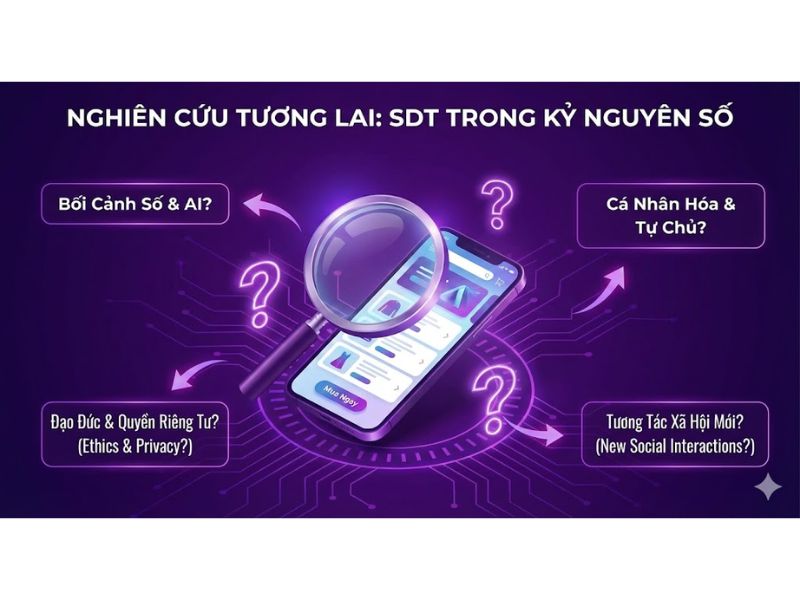
Đối với các nhà nghiên cứu và quản trị viên, việc thấu hiểu và ứng dụng linh hoạt 6 tiểu thuyết của SDT chính là chìa khóa để mở ra cánh cửa vào tâm trí và trái tim người tiêu dùng trong kỷ nguyên số.
Nếu bạn muốn nghiên cứu sâu hơn về các thang đo và mô hình chi tiết, hãy tải ngay tài liệu gốc dưới đây: