Đồng kiến tạo giá trị (Value Co-creation) là quá trình hợp tác chiến lược giữa doanh nghiệp và khách hàng nhằm tạo ra lợi ích chung. Sự mâu thuẫn trong các nghiên cứu trước đây chủ yếu do việc tách rời hai yếu tố cốt lõi: Đồng sản xuất và Giá trị sử dụng. Giải pháp đo lường chính xác nhất là áp dụng thang đo kết quả đa chiều (formative index) tích hợp cả hai khía cạnh này theo mô hình của Ranjan & Read (2016).
1. Tổng Quan & Lý Thuyết Nền Tảng (Overview & Theoretical Foundations)
1.1 Thông tin định danh bài báo
Dưới đây là thông tin gốc của công trình nghiên cứu để phục vụ trích dẫn khoa học:
- Tiêu đề gốc: Value co-creation: concept and measurement
- Tiêu đề dịch: Đồng kiến tạo giá trị: Khái niệm và đo lường
- Tác giả: Kumar Rakesh Ranjan & Stuart Read
- Nguồn: Journal of the Academy of Marketing Science (2016), 44:290–315
- DOI: 10.1007/s11747-014-0397-2
1.2 Bối cảnh nghiên cứu & Khoảng trống lý thuyết
Sự quan tâm đến Đồng kiến tạo giá trị (Value Co-creation – VCC) đang gia tăng mạnh mẽ, nhưng đi kèm với đó là sự hiểu lầm về ranh giới khái niệm.
- Vấn đề: Rà soát 149 bài báo cho thấy 79% các nghiên cứu chỉ tập trung vào một phía: hoặc là Đồng sản xuất (Co-production) hoặc là Giá trị trong quá trình sử dụng (Value-in-use).
- Hậu quả: Sự phân mảnh này dẫn đến các kết quả mâu thuẫn trong thực nghiệm.
- Mục tiêu: Bài báo này tích hợp cả hai khía cạnh để xây dựng một khung lý thuyết thống nhất và một thang đo lường định lượng chính xác.
2. Giải Quyết Mâu Thuẫn Trong Tài Liệu (Conflicts in Existing Literature)
Nghiên cứu của Ranjan & Read (2016) đã xác định hai “vấn đề nan giải” (dilemmas) trong các tài liệu trước đây do việc định nghĩa thiếu đầy đủ:
2.1 Mâu thuẫn về Chi phí và Lợi ích (Costs vs. Benefits)
- Tranh luận: Một số nghiên cứu cho rằng VCC trao quyền (empowerment) cho khách hàng, số khác lại coi đó là sự bóc lột lao động (working for free) hoặc gây căng thẳng.
- Giải quyết: Nếu chỉ nhìn vào Đồng sản xuất, khách hàng có thể cảm thấy gánh nặng. Nhưng khi kết hợp với Giá trị sử dụng (ViU), quá trình này tạo ra niềm vui, sự tự chủ và lợi ích trải nghiệm, giúp cân bằng lại chi phí bỏ ra.
2.2 Mâu thuẫn về Kết quả: Tạo ra hay Phá hủy giá trị? (Creation vs. Destruction)
- Tranh luận: VCC luôn tốt hay có thể làm giảm giá trị thương hiệu?
- Giải quyết: Các nghiên cứu tập trung vào Đồng sản xuất thường hướng đến tính hiệu quả (efficiency) (tiết kiệm chi phí đầu vào). Các nghiên cứu tập trung vào ViU hướng đến tính hiệu lực (effectiveness) (sự phù hợp và hài lòng). Mâu thuẫn nảy sinh do các nhà nghiên cứu không nhìn nhận VCC là sự tổng hòa của cả hiệu quả và hiệu lực.
3. Khái Niệm Hóa Đa Chiều (Multidimensional Conceptualization)
Đồng kiến tạo giá trị (VCC) được xác định là một cấu trúc bậc ba (third-order construct), được cấu thành bởi 2 chiều kích chính và 6 yếu tố con:
3.1 Đồng sản xuất (Co-production)
Liên quan đến sự tham gia, tương tác và chia sẻ tài nguyên trong quá trình tạo ra sản phẩm/dịch vụ.
- Kiến thức (Knowledge): Chia sẻ ý tưởng, sự sáng tạo và thông tin giữa các bên.
- Sự công bằng (Equity): Quyền kiểm soát được chia sẻ, minh bạch và mong muốn đóng góp.
- Tương tác (Interaction): Các cuộc đối thoại, giao diện làm việc và sự tham gia chủ động.
3.2 Giá trị trong quá trình sử dụng (Value-in-use – ViU)
Liên quan đến trải nghiệm thực tế và đánh giá của khách hàng khi tiêu dùng.
- Trải nghiệm (Experience): Yếu tố cảm xúc, ký ức và sự chuyển đổi cá nhân.
- Cá nhân hóa (Personalization): Tính độc nhất của việc sử dụng dựa trên bối cảnh riêng của khách hàng.
- Mối quan hệ (Relationship): Sự gắn kết, hỗ trợ từ cộng đồng và mạng lưới người dùng.
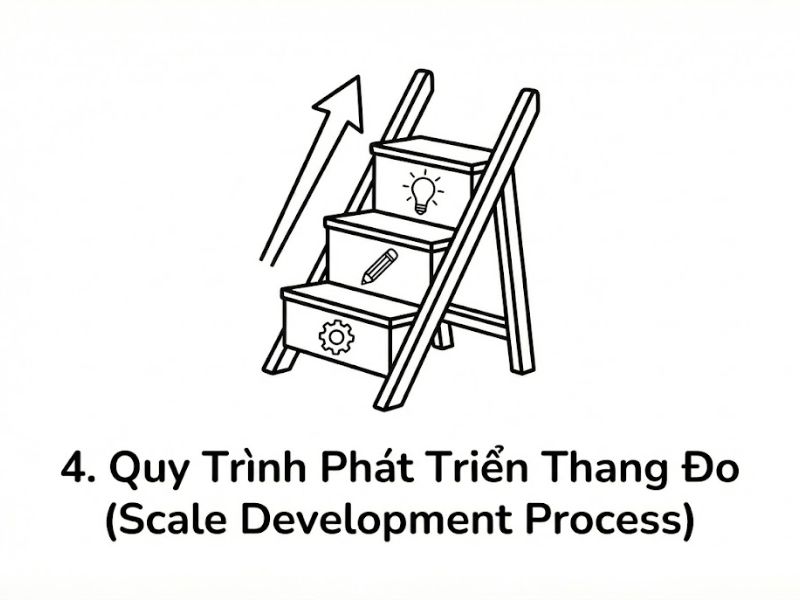
4. Quy Trình Phát Triển Thang Đo (Scale Development Process)
Để đảm bảo tính khoa học, quy trình tạo chỉ số (index construction) được thực hiện như sau:
- Tạo nguồn biến: Tổng hợp 175 biến từ 149 bài báo và các thang đo cũ.
- Thanh lọc (Purification): Sử dụng kỹ thuật Q-sort với hội đồng chuyên gia, rút gọn còn 37 biến.
- Kiểm soát đa cộng tuyến (Collinearity Check): Khảo sát 52 giám đốc điều hành. Loại bỏ 10 biến có hệ số VIF 5 để đảm bảo tính chính xác cho mô hình thang đo kết quả (formative).
- Kết quả: Bộ thang đo chính thức gồm 27 biến quan sát.
5. Thang Đo Lường Chính Thức (Measurement Scale)
Dưới đây là bộ thang đo hoàn chỉnh (đã dịch sang tiếng Việt) để sử dụng cho nghiên cứu định lượng.
Bảng 1: Thang đo Đồng sản xuất (Co-production)
| Mã | Biến gốc (Tiếng Anh) | Biến dịch (Tiếng Việt) |
| K1 | The party was open to my ideas and suggestions about its existing products or towards developing a new product. | Doanh nghiệp cởi mở với các ý tưởng và đề xuất của tôi về sản phẩm hiện tại hoặc mới. |
| K2 | The party provided sufficient illustrations and information to me. | Doanh nghiệp cung cấp đầy đủ thông tin minh họa cho tôi. |
| K3 | I would willingly spare time and effort to share my ideas… in order to help it improve its products… | Tôi sẵn lòng dành thời gian và công sức để chia sẻ ý tưởng giúp cải thiện sản phẩm. |
| K4 | The party provided suitable environment and opportunity to me to offer suggestions and ideas. | Doanh nghiệp cung cấp môi trường và cơ hội phù hợp để tôi đưa ra đề xuất. |
| E1 | The party had an easy access to information about my preferences. | Doanh nghiệp dễ dàng tiếp cận thông tin về sở thích của tôi. |
| E2 | The processes at this party are aligned with my requirements. | Quy trình của doanh nghiệp được điều chỉnh phù hợp với yêu cầu của tôi. |
| E3 | The party considered my role to be as important as its own in the process. | Doanh nghiệp coi trọng vai trò của tôi ngang bằng với chính họ. |
| E4 | We shared an equal role in determining the final outcome of the process. | Chúng tôi có vai trò bình đẳng trong việc quyết định kết quả cuối cùng. |
| I1 | During the process I could conveniently express my specific requirements. | Tôi có thể bày tỏ các yêu cầu cụ thể một cách thuận tiện. |
| I2 | The party conveyed to its consumers the relevant information related to the process. | Doanh nghiệp truyền tải thông tin liên quan đến quy trình cho khách hàng. |
| I3 | The party allowed sufficient consumer interaction in its business processes. | Doanh nghiệp cho phép khách hàng tương tác đầy đủ trong quy trình kinh doanh. |
| I4 | In order to get maximum benefit… I had to play a proactive role during my interaction. | Để đạt lợi ích tối đa, tôi phải đóng vai trò chủ động khi tương tác. |
Bảng 2: Thang đo Giá trị trong sử dụng (Value-in-use)
| Mã | Biến gốc (Tiếng Anh) | Biến dịch (Tiếng Việt) |
| X1 | It was a memorable experience for me. | Đó là một trải nghiệm đáng nhớ đối với tôi. |
| X2 | Depending upon the nature of my own participation, my experiences… might be different… | Trải nghiệm của tôi có thể khác biệt tùy thuộc vào sự tham gia của chính tôi. |
| X3 | It was possible for a consumer to improve the process by experimenting and trying new things. | Khách hàng có thể cải thiện quy trình bằng cách thử nghiệm điều mới. |
| P1 | The benefit, value, or fun… depended on the user and the usage condition. | Lợi ích/giá trị phụ thuộc vào người dùng và điều kiện sử dụng. |
| P2 | The party tried to serve the individual needs of each of its consumer. | Doanh nghiệp cố gắng phục vụ nhu cầu cá nhân của từng khách hàng. |
| P3 | Different consumers… involve themselves differently in the process. | Khách hàng khác nhau tham gia vào quy trình theo cách khác nhau. |
| P4 | The party provided an overall good experience, beyond the “functional” benefit. | Doanh nghiệp mang lại trải nghiệm tốt đẹp vượt ra ngoài lợi ích chức năng. |
| R1 | The party’s extended facilitation is necessary for consumers to fully enjoy the process. | Sự hỗ trợ mở rộng là cần thiết để khách hàng tận hưởng trọn vẹn. |
| R2 | I felt an attachment or relationship with the party. | Tôi cảm thấy có sự gắn kết hoặc mối quan hệ với doanh nghiệp. |
| R3 | There was usually a group, a community… who are a fan of the party. | Thường có một cộng đồng/nhóm người hâm mộ doanh nghiệp này. |
| R4 | The party was renowned because its consumers usually spread positive word… | Doanh nghiệp nổi tiếng nhờ khách hàng lan truyền lời tốt đẹp. |
6. Mạng Lưới Quan Hệ Lý Thuyết (Nomological Network)
Để kiểm định giá trị dự báo (predictive validity) và vị trí của VCC trong hệ thống lý thuyết marketing, nhóm tác giả đã xây dựng và kiểm định mạng lưới quan hệ (Nghiên cứu 2 với n=230) như sau:
6.1 Các tiền tố (Antecedents)
Trong mô hình này, Đồng sản xuất và Giá trị trong sử dụng (ViU) đóng vai trò là các thành phần cấu tạo (formative components).
- Đồng sản xuất được hình thành từ: Kiến thức, Sự công bằng, Tương tác.
- ViU được hình thành từ: Trải nghiệm, Cá nhân hóa, Mối quan hệ.
- Kết quả phân tích PLS cho thấy các biến này giải thích lần lượt 46% (Đồng sản xuất) và 38% (ViU) phương sai của cấu trúc.
6.2 Các hậu tố (Consequences)
Mối quan hệ quan trọng nhất được kiểm định là tác động của VCC đến Sự hài lòng của người tiêu dùng (Consumer Satisfaction).
- Kết quả: VCC có tác động tích cực và có ý nghĩa thống kê lên sự hài lòng.
- Hệ số đường dẫn (Path Coefficient): $\beta = 0.43$ (p < 0.001).
- Hệ số xác định ($R^2$): 0.19. Điều này có nghĩa là mức độ tham gia vào đồng kiến tạo giá trị giải thích được 19% sự thay đổi trong mức độ hài lòng của khách hàng.
6.3 Kiểm định tính chất thang đo (Reflective vs. Formative)
Tác giả sử dụng kiểm định Tetrad (Vanishing Tetrad Analysis) và tương quan giữa các biến (trung bình r = 0.12, khá thấp).
- Kết luận: VCC phù hợp nhất với mô hình thang đo kết quả (formative model). Các biến con là nguyên nhân tạo nên VCC, không phải là kết quả phản ánh của VCC.
7. Hướng Dẫn Ứng Dụng Nghiên Cứu (Academic Implications)
Nghiên cứu này cung cấp một lộ trình rõ ràng cho các học giả muốn đi sâu vào lĩnh vực VCC:
- Sử dụng trọn vẹn mô hình: Các nhà nghiên cứu cần tránh sai lầm của các nghiên cứu trước đây (chỉ chọn 1 trong 2 chiều kích). Để đo lường chính xác Đồng kiến tạo giá trị, bắt buộc phải đưa cả Đồng sản xuất và ViU vào mô hình nghiên cứu.
- Thiết lập mô hình đo lường: Khi sử dụng phần mềm phân tích (như SmartPLS hay AMOS), cần thiết lập VCC là biến tiềm ẩn bậc cao dạng kết quả (High-order formative construct). Các mũi tên phải đi từ biến quan sát hướng vào biến tiềm ẩn.
- Kiểm soát chất lượng dữ liệu: Do sử dụng thang đo kết quả, hiện tượng đa cộng tuyến là một rủi ro lớn. Nhà nghiên cứu cần kiểm tra kỹ chỉ số VIF (Variance Inflation Factor) và đảm bảo chúng nằm trong ngưỡng cho phép (dưới 3.3 hoặc dưới 5 tùy tiêu chuẩn).
- Mở rộng mạng lưới lý thuyết: Nghiên cứu tương lai nên khám phá thêm các tiền tố (ví dụ: đặc điểm tính cách khách hàng) và các hậu tố khác ngoài sự hài lòng (ví dụ: lòng trung thành, ý định mua lại, giá trị trọn đời khách hàng).
8. Ứng Dụng Quản Trị Doanh Nghiệp (Managerial Implications)
Đối với các nhà quản trị chiến lược và Marketer, nghiên cứu này đưa ra các hàm ý thực tiễn sâu sắc:
- Chuyển đổi tư duy quản trị: Doanh nghiệp không nên chỉ coi khách hàng là “người mua” thụ động. Hãy xem họ là đối tác (partner) có khả năng đóng góp tri thức và sáng tạo. Tuy nhiên, đừng chỉ dừng lại ở việc lấy ý kiến (Đồng sản xuất), mà phải quan tâm đến việc họ cảm thấy thế nào khi sử dụng sản phẩm (ViU).
- Đầu tư vào nền tảng tương tác: Để tăng cường yếu tố Sự công bằng (Equity) và Tương tác (Interaction), doanh nghiệp cần xây dựng các kênh giao tiếp minh bạch, nơi khách hàng thấy ý kiến của họ được lắng nghe và tôn trọng.
- Tối ưu hóa giai đoạn sau mua: Giá trị thực sự của VCC nằm ở Giá trị sử dụng (ViU). Các nhà quản lý cần thiết kế các dịch vụ hỗ trợ, cộng đồng người dùng và các tính năng tùy biến để khách hàng có thể “cá nhân hóa” trải nghiệm của họ, từ đó gia tăng sự hài lòng tổng thể ($\beta = 0.43$).
- Xây dựng cộng đồng thương hiệu: Yếu tố Mối quan hệ (Relationship) là một phần của VCC. Doanh nghiệp nên khuyến khích việc hình thành các nhóm người dùng, diễn đàn hoặc fanpage để khách hàng tự hỗ trợ và lan truyền giá trị cho nhau.
9. Tài Liệu Tham Khảo (References)
(Danh sách tài liệu tham khảo được trình bày theo chuẩn APA, tách dòng đầy đủ để phục vụ tra cứu).
Aaker, J. L. (1997). Dimensions of brand personality. Journal of Marketing Research, 34(3), 347–356.
Aarikka-Stenroos, L., & Jaakkola, E. (2012). Value co-creation in knowledge intensive business services: a dyadic perspective on the joint problem solving process. Industrial Marketing Management, 41(1), 15–26.
Achrol, R., & Kotler, P. (2012). Frontiers of the marketing paradigm in the third millennium. Journal of the Academy of Marketing Science, 40(1), 35–52.
Aitken, R., & Campelo, A. (2011). The four Rs of place branding. Journal of Marketing Management, 27(9/10), 913–933.
Anderson, P. F. (1983). Marketing, scientific progress, and scientific method. The Journal of Marketing, 47(4), 18–31.
Archpru Akaka, M., & Chandler, J. D. (2011). Roles as resources: a social roles perspective of change in value networks. Marketing Theory, 11(3), 243–260.
Arndt, J. (1985). On making marketing science more scientific: role of orientations, paradigms, metaphors, and puzzle solving. The Journal of Marketing, 49(3), 11–23.
Arnett, D. B., Laverie, D. A., & Meiers, A. (2003). Developing parsimonious retailer equity indexes using partial least squares analysis: a method and applications. Journal of Retailing, 79(3), 161–170.
Arnold, S. J., & Fischer, E. (1994). Hermeneutics and consumer research. Journal of Consumer Research, 21(1), 55–70.
Arnould, E. J., & Price, L. L. (1993). River magic: extraordinary experience and the extended service encounter. Journal of Consumer Research, 20(1), 24.
Arvidsson, A. (2011). Ethics and value in customer co-production. Marketing Theory, 11(3), 261–278.
Auh, S., Bell, S. J., McLeod, C. S., & Shih, E. (2007). Co-production and customer loyalty in financial services. Journal of Retailing, 83(3), 359–370.
Bagozzi, R., Verbeke, W., Berg, W., Rietdijk, W., Dietvorst, R., & Worm, L. (2012). Genetic and neurological foundations of customer orientation: field and experimental evidence. Journal of the Academy of Marketing Science, 40(5), 639–658.
Ballantyne, D., & Varey, R. J. (2006). Creating value-in-use through marketing interaction: the exchange logic of relating, communicating and knowing. Marketing Theory, 6(3), 335–348.
Ballantyne, D., & Varey, R. J. (2008). The service-dominant logic and the future of marketing. Journal of the Academy of Marketing Science, 36(1), 11–14.
Becker, J.-M., Klein, K., & Wetzels, M. (2012). Hierarchical latent variable models in PLS-SEM: guidelines for using reflective-formative type models. Long Range Planning, 45(5–6), 359–394.
Belk, R. W., Sherry, J. F., Jr., & Wallendorf, M. (1988). A naturalistic inquiry into buyer and seller behavior at a swap meet. Journal of Consumer Research, 14(4), 449–470.
Belk, R. W., Wallendorf, M., & Sherry, J. F., Jr. (1989). The sacred and the profane in consumer behavior: theodicy on the odyssey. Journal of Consumer Research, 16(1), 1–38.
Bendapudi, N., & Leone, R. P. (2003). Psychological implications of customer participation in co-production. Journal of Marketing, 67(1), 14–28.
Bettencourt, L. A., & Brown, S. W. (1997). Contact employees: relationships among workplace fairness, job satisfaction and prosocial service behaviors. Journal of Retailing, 73(1), 39–61.
Bollen, K. A. (1989). A new incremental fit index for general structural equation models. Sociological Methods & Research, 17(3), 303–316.
Bollen, K., & Lennox, R. (1991). Conventional wisdom on measurement: a structural equation perspective. Psychological Bulletin, 110(2), 305.
Bollen, K. A., & Ting, K.-F. (2000). A tetrad test for causal indicators. Psychological Methods, 5(1), 3–22.
Bolton, R., & Saxena-Iyer, S. (2009). Interactive services: a framework, synthesis and research directions. Journal of Interactive Marketing, 23(1), 91–104.
Bolton, R. N., Day, G. S., Deighton, J., Narayandas, D., Gummesson, E., Hunt, S. D., & Shugan, S. M. (2004). Invited commentaries on “evolving to a new dominant logic for marketing”. Journal of Marketing, 68(1), 18–27.
Bonsu, S. K., & Darmody, A. (2008). Co-creating second life: market-consumer cooperation in contemporary economy. Journal of Macromarketing, 28(4), 355–368.
Boselli, R., Cesarini, M., & Mezzanzanica, M. (2008). Customer knowledge and service development, the web 2.0 role in co-production. Proceedings of World Academy of Science, Engineering, and Technology, 30, Parigi, July.
Brady, M. K., Knight, G. A., Cronin, J. J., Tomas, G., Hult, M., & Keillor, B. D. (2005). Removing the contextual lens: a multinational, multi-setting comparison of service evaluation models. Journal of Retailing, 81(3), 215–230.
Brakus, J., Schmitt, B., & Zarantonello, L. (2009). Brand experience: what is it? how is it measured? does it affect loyalty? Journal of Marketing, 73(3), 52–68.
Bruhn, M., Georgi, D., & Hadwich, K. (2008). Customer equity management as formative second-order construct. Journal of Business Research, 61(12), 1292–1301.
Buchanan-Oliver, M., & Seo, Y. (2012). Play as co-created narrative in computer game consumption: the hero’s journey in warcraft III. Journal of Consumer Behaviour, 11(6), 423–431.
Cadeaux, J. (2008). Transition strategies between product space and service time: user assets, search characteristics, and co-production. Journal of Strategic Marketing, 16(1), 75–87.
Carroll, B. A., & Ahuvia, A. C. (2006). Some antecedents and outcomes of brand love. Marketing Letters, 17(2), 79–89.
Chan, K. W., Yim, C. K., & Lam, S. S. K. (2010). Is customer participation in value creation a double-edged sword? evidence from professional financial services across cultures. Journal of Marketing, 74(3), 48–64.
Chandler, J. D., & Vargo, S. L. (2011). Contextualization and value-in-context: how context frames exchange. Marketing Theory, 11(1), 35–49.
Chang, K.-H., & Gotcher, D. F. (2010). Conflict-coordination learning in marketing channel relationships: the distributor view. Industrial Marketing Management, 39(2), 287–297.
Chathoth, P., Altinay, L., Harrington, R. J., Okumus, F., & Chan, E. S. W. (2012). Co-production versus co-creation: a process based continuum in the hotel service context. International Journal of Hospitality Management, 32(March), 11–20.
Chen, J. S., Tsou, H. T., & Ching, R. K. H. (2011). Co-production and its effects on service innovation. Industrial Marketing Management, 40(8), 1331–1346.
Cheung, M. F. Y., & To, W. (2011). Customer involvement and perceptions: the moderating role of customer co-production. Journal of Retailing and Consumer Services, 18(4), 271–277.
Chien, S.-H., & Chen, J.-J. (2010). Supplier involvement and customer involvement effect on new product development success in the financial service industry. The Service Industries Journal, 30(2), 185–201.
Chin, W. W. (1998). The partial least squares approach to structural equation modeling. In G. A. Marcoulides (Ed.), Modern methods for business research (pp. 295–336). Mahwah: Lawrence Erlbaum Associates Inc.
Chunyan, X., Bagozzi, R. P., & Troye, S. V. (2008). Trying to prosume: toward a theory of consumers as co-creators of value. Journal of the Academy of Marketing Science, 36(1), 109–122.
Cova, B. (1997). Community and consumption: towards a definition of the “linking value” of product or services. European Journal of Marketing, 31(3/4), 297–316.
Cova, B., & Salle, R. (2008). Marketing solutions in accordance with the S-D logic: co-creating value with customer network actors. Industrial Marketing Management, 37(3), 270–277.
Cova, B., Dalli, D., & Zwick, D. (2011). Critical perspectives on consumers’ role as ‘producers’: broadening the debate on value co-creation in marketing processes. Marketing Theory, 11(3), 231–241.
Cronin, J. J., Brady, M. K., & Hult, G. T. M. (2000). Assessing the effects of quality, value, and customer satisfaction on consumer behavioral intentions in service environments. Journal of Retailing, 76(2), 193–218.
Cudeck, R., & Browne, M. W. (1983). Cross-validation of covariance structures. Multivariate Behavioral Research, 18(2), 147–167.
Dagger, T. S., Sweeney, J. C., & Johnson, L. W. (2007). A hierarchical model of health service quality: scale development and Investigation of an integrated model. Journal of Service Research, 10(2), 123–142.
Dahl, D. W., & Moreau, C. P. (2007). Thinking inside the box: why consumers enjoy constrained creative experiences. Journal of Marketing Research, 44(3), 357–369.
Dato-on, M. C., & Beasley, F. (2005). A proposed cross-national study: the effects of self-serving bias and co-production on customer satisfaction. Innovative Marketing, 1(2), 40–48.
DeBerry-Spence, B. (2008). Consumer creations of product meaning in the context of African-style clothing. Journal of the Academy of Marketing Science, 36(3), 395–408.
Delgado-Ballester, E., & Munuera-Alemán, J. L. (2005). Does brand trust matter to brand equity? Journal of Product & Brand Management, 14(3), 187–196.
Devasirvatham, E. R. (2012). Modelling co-creation and its consequences: one step closer to customer-centric marketing. AUT University.
Dholakia, U. M., Blazevic, V., Wiertz, C., & Algesheimer, R. (2009). Communal service delivery: how customers benefit from participation in firm-hosted virtual P3 communities. Journal of Service Research, 12(2), 208–226.
Diamantopoulos, A., & Siguaw, J. A. (2006). Formative versus reflective indicators in organizational measure development: a comparison and empirical illustration. British Journal of Management, 17(4), 263–282.
Diamantopoulos, A., & Winklhofer, H. M. (2001). Index construction with formative indicators: an alternative to scale development. Journal of Marketing Research, 38(2), 269–277.
Diamantopoulos, A., Riefler, P., & Roth, K. P. (2008). Advancing formative measurement models. Journal of Business Research, 61(12), 1203–1218.
Dong, B., Evans, K. R., & Zou, S. (2008). The effects of customer participation in co-created service recovery. Journal of the Academy of Marketing Science, 36(1), 123–137.
Droge, C., Stanko, M. A., & Pollitte, W. A. (2010). Lead users and early adopters on the web: the role of new technology product blogs. Journal of Product Innovation Management, 27(1), 66–82.
Echeverri, P., & Skålén, P. (2011). Co-creation and co-destruction: a practice-theory based study of interactive value formation. Marketing Theory, 11(3), 351–373.
Edvardsson, B., Gustafsson, A., & Roos, I. (2005). Service portraits in service research: a critical review. International Journal of Service Industry Management, 16(1), 107–121.
Edvardsson, B., Enquist, B., & Johnston, R. (2010). Design dimensions of experience rooms for service test drives: case studies in several service contexts. Managing Service Quality, 20(4), 312–327.
Edvardsson, B., Ng, G., Min, C. Z., Firth, R., & Yi, D. (2011). Does service-dominant design result in a better service system? Journal of Service Management, 22(4), 540–556.
Edwards, J. R., & Bagozzi, R. P. (2000). On the nature and direction of relationships between constructs and measures. Psychological Methods, 5(2), 155.
Enz, M. G., & Lambert, D. M. (2012). Using cross-functional, cross-firm teams to co-create value: the role of financial measures. Industrial Marketing Management, 41(3), 495–507.
Ertimur, B., & Venkatesh, A. (2010). Opportunism in co-production: implications for value co-creation. Australasian Marketing Journal, 18(4), 256–263.
Etgar, M. (2008). A descriptive model of the consumer co-production process. Journal of the Academy of Marketing Science, 36(1), 97–108.
Fang, E., Palmatier, R. W., & Evans, K. R. (2008). Influence of customer participation on creating and sharing of new product value. Journal of the Academy of Marketing Science, 36(3), 322–336.
Ferguson, R. J., Paulin, M., & Bergeron, J. (2010). Customer sociability and the total service experience. Journal of Service Management, 21(1), 25–44.
Fisher, D., & Smith, S. (2011). Cocreation is chaotic: what it means for marketing when no one has control. Marketing Theory, 11(3), 325–350.
Ford, D. (2011). IMP and service-dominant logic: divergence, convergence and development. Industrial Marketing Management, 40(2), 231–239.
Fornell, C., & Larcker, D. F. (1981). Evaluating structural equation models with unobservable variables and measurement error. Journal of Marketing Research, 18(1), 39–50.
Fournier, S. (1998). Consumers and their brands: developing relationship theory in consumer research. Journal of Consumer Research, 24(4), 343–353.
Füller, J. (2010). Refining virtual co-creation from a consumer perspective. California Management Review, 52(2), 98–122.
Grönroos, C. (2006). Adopting a service logic for marketing. Marketing Theory, 6(3), 317–333.
Grönroos, C. (2008). Service logic revisited: who creates value? and who co-creates? European Business Review, 20(4), 298–314.
Grönroos, C. (2011). Value co-creation in service logic: a critical analysis. Marketing Theory, 11(3), 279–301.
Grönroos, C. (2012). Conceptualising value co-creation: a journey to the 1970s and back to the future. Journal of Marketing Management, 28(13/14), 1520–1534.
Grönroos, C., & Ravald, A. (2011). Service as business logic: implications for value creation and marketing. Journal of Service Management, 22(1), 5–22.
Grönroos, C., & Voima, P. (2013). Critical service logic: making sense of value creation and co-creation. Journal of the Academy of Marketing Science, 41(2), 133–150.
Grove, S. J., & Fisk, R. P. (1997). The impact of other customers on service experiences: a critical incident examination of “getting along”. Journal of Retailing, 73(1), 63–85.
Grover, V., & Kohli, R. (2012). Cocreating IT value: new capabilities and metrics for multifirm environments. MIS Quarterly, 36(1), 225–232.
Gummerus, J., & Pihlström, M. (2011). Context and mobile services’ value-in-use. Journal of Retailing and Consumer Services, 18(6), 521–533.
Gummesson, E. (2008). Quality, service-dominant logic and many-to-many marketing. TQM Journal, 20(2), 143–153.
Haahti, A. (2003). Theory of relationship cultivation: a point of view to design of experience. Journal of Business & Management, 9(3), 303–321.
Hair, J. F., Sarstedt, M., Ringle, C. M., & Mena, J. A. (2012). An assessment of the use of partial least squares structural equation modeling in marketing research. Journal of the Academy of Marketing Science, 40(3), 414–433.
Heidenreich, S., Wittkowski, K., Handrich, M., & Falk, T. (2014). The dark side of customer co-creation: exploring the consequences of failed co-created services. Journal of the Academy of Marketing Science, 1–18.
Heiko, G., Mikael, J., & Bo, E. (2010). Value co-creation as a determinant of success in public transport services: a study of the swiss federal railway operator (SBB). Managing Service Quality, 20(6), 511–530.
Heinonen, K., & Strandvik, T. (2009). Monitoring value-in-use of e-service. Journal of Service Management, 20(1), 33–51.
Heinonen, K., Strandvik, T., Mickelsson, K.-J., Edvardsson, B., Sundström, E., & Andersson, P. (2010). A customer-dominant logic of service. Journal of Service Management, 21(4), 531–548.
Hirschman, E. C. (1986). Humanistic inquiry in marketing research: philosophy, method, and criteria. Journal of Marketing Research (JMR), 23(3), 237–249.
Hofstede, G. (1983). The cultural relativity of organizational practices and theories. Journal of International Business Studies, 14(2), 75–89.
Holbrook, M. B., & Hirschman, E. C. (1982). The experiential aspects of consumption: consumer fantasies, feelings, and fun. Journal of Consumer Research, 9(2), 132–140.
Hoyer, W. D., Chandy, R., Dorotic, M., Krafft, M., & Singh, S. S. (2010). Consumer cocreation in new product development. Journal of Service Research, 13(3), 283–296.
Hu, Y., & McLoughlin, D. (2012). Creating new market for industrial services in nascent fields. Journal of Services Marketing, 26(5), 322–331.
Hunt, S. D. (1976). The nature and scope of marketing. The Journal of Marketing, 40(3), 17–28.
Hunt, S. D. (1990). Truth in marketing theory and research. The Journal of Marketing, 54(3), 1–15.
Hunt, D. M., Geiger-Oneto, S., & Varca, P. E. (2012). Satisfaction in the context of customer co-production: a behavioral involvement perspective. Journal of Consumer Behaviour, 11(5), 347–356.
Jarvis, C. B., MacKenzie, S. B., & Podsakoff, P. M. (2003). A critical review of construct indicators and measurement model misspecification in marketing and consumer research. Journal of Consumer Research, 30(2), 199–218.
Jones, M., & Millar, C. (2010). About global leadership and global ethics, and a possible moral compass: an introduction to the special issue. Journal of Business Ethics, 93, 1–8.
Karpen, I. O., Bove, L. L., & Lukas, B. A. (2012). Linking service-dominant logic and strategic business practice: a conceptual model of a service-dominant orientation. Journal of Service Research, 15(1), 21–38.
Kates, S. M. (2004). The dynamics of brand legitimacy: an interpretive study in the gay men’s community. Journal of Consumer Research, 31(2), 455–464.
Kohler, T., Fueller, J., Matzler, K., & Stieger, D. (2011). Co-creation relation in virtual worlds: the design of the user experience. MIS Quarterly, 35(3), 773–788.
Kohli, A. K., Jaworski, B. J., & Kumar, A. (1993). MARKOR: a measure of market orientation. Journal of Marketing Research, 30(4), 467–477.
Kozinets, R. V., Sherry, J. F., DeBerry-Spence, B., Duhachek, A., Nuttavuthisit, K., & Storm, D. (2002). Themed flagship brand stores in the new millennium: theory, practice, prospects. Journal of Retailing, 78(1), 17–29.
Krishna, A., & Morrin, M. (2008). Does touch affect taste? The perceptual transfer of product container haptic cues. Journal of Consumer Research, 34(6), 807–818.
Kristensson, P., Matthing, J., & Johansson, N. (2008). Key strategies for the successful involvement of customers in the co-creation of new technology-based services. International Journal of Service Industry Management, 19(4), 474–491.
Lambert, D. M., & Enz, M. G. (2012). Managing and measuring value co-creation in business-to-business relationships. Journal of Marketing Management, 28(13–14), 1588–1625.
Landis, J. R., & Koch, G. G. (1977). The measurement of observer agreement for categorical data. Biometrics, 33(1), 159–174.
Lemke, F., Clark, M., & Wilson, H. (2011). Customer experience quality: an exploration in business and consumer contexts using repertory grid technique. Journal of the Academy of Marketing Science, 39(6), 846–869.
Lengnick-Hall, C. A. (1996). Customer contributions to quality: a different view of the customer-oriented firm. Academy of Management Review, 21(3), 791–824.
Leroy, J., Cova, B., & Salle, R. (2013). Zooming in VS zooming out on value co-creation: consequences for BtoB research. Industrial Marketing Management, 42(7), 1102–1111.
Ligas, M., & Cotte, J. (1999). The process of negotiating brand meaning: a symbolic interactionist perspective. Advances in Consumer Research, 26, 609–614.
Lusch, R. F., & Vargo, S. L. (2006). Service-dominant logic: reactions, reflections and refinements. Marketing Theory, 6(3), 281–288.
Lusch, R. F., Vargo, S. L., & O’Brien, M. (2007). Competing through service: Insights from service-dominant logic. Journal of Retailing, 83(1), 5–18.
MacCallum, R. C., & Browne, M. W. (1993). The use of causal indicators in covariance structure models: some practical issues. Psychological Bulletin, 114(3), 533–541.
Macdonald, E. K., Wilson, H., Martinez, V., & Toossi, A. (2011). Assessing value-in-use: a conceptual framework and exploratory study. Industrial Marketing Management, 40(5), 671–682.
MacKenzie, S. B., Podsakoff, P. M., & Jarvis, C. B. (2005). The problem of measurement model misspecification in behavioral and organizational research and some recommended solutions. Journal of Applied Psychology, 90(4), 710.
Maclaran, P., & Brown, S. (2005). The center cannot hold: consuming the utopian marketplace. Journal of Consumer Research, 32(2), 311–323.
Madhavaram, S., & Hunt, S. D. (2008). The service-dominant logic and a hierarchy of operant resources: developing masterful operant resources and implications for marketing strategy. Journal of the Academy of Marketing Science, 36(1), 67–82.
Maglio, P. P., & Spohrer, J. (2008). Fundamentals of service science. Journal of the Academy of Marketing Science, 36(1), 18–20.
Mallapragada, G., Grewal, R., & Lilien, G. (2012). User-generated open source products: founder’s social capital and time to product release. Marketing Science, 31(3), 474–492.
McColl-Kennedy, J. R., Vargo, S. L., Dagger, T. S., Sweeney, J. C., & van Kasteren, Y. (2012). Health care customer value cocreation practice styles. Journal of Service Research, 15(4), 370–389.
Mele, C. (2011). Conflicts and value co-creation in project networks. Industrial Marketing Management, 40(8), 1377–1385.
Merz, M. A., Yi, H., & Vargo, S. L. (2009). The evolving brand logic: a service-dominant logic perspective. Journal of the Academy of Marketing Science, 37(3), 328–344.
Michel, S., Brown, S. W., & Gallan, A. S. (2008). Service-logic innovations: how to innovate customers, not products. California Management Review, 50(3), 49–65.
Moeller, S. (2008). Customer integration a key to an implementation perspective of service provision. Journal of Service Research, 11(2), 197–210.
Mohr, J. J., & Sarin, S. (2009). Drucker’s insights on market orientation and innovation: implications for emerging areas in high-technology marketing. Journal of the Academy of Marketing Science, 37(1), 85–96.
Möller, K., Rajala, R., & Westerlund, M. (2008). Service innovation myopia? a new recipe for client-provider value creation. California Management Review, 50(3), 31–48.
Moreau, C. P., & Herd, K. B. (2010). To each his own? how comparisons with others influence consumers’ evaluations of their self-designed products. Journal of Consumer Research, 36(5), 806–819.
Morgan, R. M., & Hunt, S. D. (1994). The commitment-trust theory of relationship marketing. The Journal of Marketing, 58(3), 20–38.
Nambisan, S., & Baron, R. A. (2007). Interactions in virtual customer environments: implications for product support and customer relationship management. Journal of Interactive Marketing, 21(2), 42–62.
Ng, I. C. L. (2010). Value and systems perspectives in combining human and automated services: commentary on “seven challenges to combining human and automated service”. Canadian Journal of Administrative Sciences, 27(1), 81–84.
Ng, I. C. L., Maull, R., & Yip, N. (2009). Outcome-based contracts as a driver for systems thinking and service-dominant logic in service science: evidence from the defence industry. European Management Journal, 27(6), 377–387.
Ng, I. C. L., Nudurupati, S. S., & Tasker, P. (2010). Value co-creation in the delivery of outcome-based contracts for business-to-business service. Advanced Institute of Management (AIM) Research: Working paper series.
Nuttavuthisit, K. (2010). If you can’t beat them, let them join: the development of strategies to foster consumers’ co-creative practices. Business Horizons, 53(3), 315–324.
O’Neill, M., & Palmer, A. (2003). An exploratory study of the effects of experience on consumer perceptions of the service quality construct. Managing Service Quality, 13(3), 187–196.
Oliver, R. L. (1999). Whence consumer loyalty? The Journal of Marketing, 63(Special issue), 33–44.
Ordanini, A., & Pasini, P. (2008). Service co-production and value co-creation: the case for a service-oriented architecture (SOA). European Management Journal, 26(5), 289–297.
Ordanini, A., Miceli, L., Pizzetti, M., & Parasuraman, A. (2011). Crowd-funding: transforming customers into investors through innovative service platforms. Journal of Service Management, 22(4), 443–470.
Ostrom, A. L., Bitner, M. J., Brown, S. W., Burkhard, K. A., Goul, M., Smith-Daniels, V., & Rabinovich, E. (2010). Moving forward and making a difference: research priorities for the science of service. Journal of Service Research, 13(1), 4–36.
Parasuraman, A., Zeithaml, V. A., & Berry, L. L. (1988). SERVQUAL: a multiple-item scale for measuring consumer perceptions of service quality. Journal of Retailing, 64(1), 12–37.
Parry, G., Bustinza, O. F., & Vendrell-Herrero, F. (2012). Servitisation and value co-production in the UK music industry: an empirical study of consumer attitudes. International Journal of Production Economics, 135(1), 320–332.
Payne, A. F., Storbacka, K., & Frow, P. (2008). Managing the co-creation of value. Journal of the Academy of Marketing Science, 36(1), 83–96.
Payne, A., Storbacka, K., Frow, P., & Knox, S. (2009). Co-creating brands: diagnosing and designing the relationship experience. Journal of Business Research, 62(3), 379–389.
Peñaloza, L., & Mish, J. (2011). The nature and processes of market co-creation in triple bottom line firms: leveraging insights from consumer culture theory and service dominant logic. Marketing Theory, 11(1), 9–34.
Peñaloza, L., & Venkatesh, A. (2006). Further evolving the new dominant logic of marketing: from services to the social construction of markets. Marketing Theory, 6(3), 299–316.
Petter, S., Straub, D., & Rai, A. (2007). Specifying formative constructs in information systems research. MIS Quarterly, 31(4), 623–656.
Pine, B. J., & Gilmore, J. H. (1998). Welcome to the experience economy. Harvard Business Review, 76(July–August), 97–105.
Pongsakornrungsilp, S., & Schroeder, J. E. (2011). Understanding value co-creation in a co-consuming brand community. Marketing Theory, 11(3), 303–324.
Powell, J. H., & Swart, J. (2010). Mapping the values in B2B relationships: a systemic, knowledge-based perspective. Industrial Marketing Management, 39(3), 437–449.
Prahalad, C. K., & Ramaswamy, V. (2000). Co-opting customer competence. Harvard Business Review, 78(1), 79–90.
Prahalad, C. K., & Ramaswamy, V. (2002). The co-creation connection. Strategy and Business, 50–61.
Prahalad, C. K., & Ramaswamy, V. (2004a). Co-creating unique value with customers. Strategy & Leadership, 32(3), 4–9.
Prahalad, C. K., & Ramaswamy, V. (2004b). Co-creation experiences: the next practice in value creation. Journal of Interactive Marketing, 18(3), 5–14.
Ramani, G., & Kumar, V. (2008). Interaction orientation and firm performance. Journal of Marketing, 72(1), 27–45.
Ramirez, R. (1999). Value co-production: intellectual origins and implications for practice and research. Strategic Management Journal, 20(1), 49–65.
Reinartz, W., Krafft, M., & Hoyer, W. D. (2004). The customer relationship management process: its measurement and impact on performance. Journal of Marketing Research, 41(3), 293–305.
Roggeveen, A., Tsiros, M., & Grewal, D. (2012). Understanding the co-creation effect: when does collaborating with customers provide a lift to service recovery? Journal of the Academy of Marketing Science, 40(6), 771–790.
Rossiter, J. R. (2002). The C-OAR-SE procedure for scale development in marketing. International Journal of Research in Marketing, 19(4), 305–335.
Round, D. J. G., & Roper, S. (2012). Exploring consumer brand name equity. European Journal of Marketing, 46(7/8), 938–951.
Sandström, S., Edvardsson, B., Kristensson, P., & Magnusson, P. (2008). Value in use through service experience. Managing Service Quality, 18(2), 112–126.
Sarker, S., Sarker, S., Sahaym, A., & Bjørn-Andersen, N. (2012). Exploring value cocreation in relationships between an ERP vendor and its partners: a revelatory case study. MIS Quarterly, 36(1), 317–338.
Sawhney, M., Verona, G., & Prandelli, E. (2005). Collaborating to create: the internet as a platform for customer engagement in product innovation. Journal of Interactive Marketing, 19(4), 4–17.
Sharma, A., & Sheth, J. N. (2004). Web-based marketing: the coming revolution in marketing thought and strategy. Journal of Business Research, 57(7), 696–702.
Snepenger, D., Snepenger, M., Dalbey, M., & Wessol, A. (2007). Meanings and consumption characteristics of places at a tourism destination. Journal of Travel Research, 45(3), 310–321.
Sorescu, A., Frambach, R. T., Singh, J., Rangaswamy, A., & Bridges, C. (2011). Innovations in retail business models. Journal of Retailing, 87(July), S3–S16.
Storbacka, K., & Nenonen, S. (2011). Scripting markets: from value propositions to market propositions. Industrial Marketing Management, 40(2), 255–266.
Strandvik, T., Holmlund, M., & Edvardsson, B. (2012). Customer needing: a challenge for the seller offering. Journal of Business & Industrial Marketing, 27(2), 132–141.
Strauss, A., & Corbin, J. (2007). Basics of qualitative research: Techniques and procedures for developing grounded theory. Sage Publications, Incorporated.
Szmigin, I., & Foxall, G. (2000). Interpretive consumer research: how far have we come? Qualitative Market Research: An International Journal, 3(4), 187–197.
Thompson, C. J., Locander, W. B., & Pollio, H. R. (1989). Putting consumer experience back into consumer research: the philosophy and method of existential-phenomenology. Journal of Consumer Research, 16(2), 133–146.
Thomson, M., MacInnis, D. J., & Park, C. W. (2005). The ties that bind: measuring the strength of consumers’ emotional attachments to brands. Journal of Consumer Psychology, 15(1), 77–91.
Troye, S. V., & Supphellen, M. (2012). Consumer participation in coproduction: “I made it myself” effects on consumers’ sensory perceptions and evaluations of outcome and input product. Journal of Marketing, 76(2), 33–46.
Tung, W. F., & Yuan, S. T. (2008). A service design framework for value co-production: insight from mutualism perspective. Kybernetes, 37(2), 226–240.
Tynan, C., McKechnie, S., & Chhuon, C. (2010). Co-creating value for luxury brands. Journal of Business Research, 63(11), 1156–1163.
Vallaster, C., & von Wallpach, S. (2012). An online discursive inquiry into the social dynamics of multi-stakeholder brand meaning co-creation. Journal of Business Research, 66(9), 1505–1515.
Vargo, S. L., & Lusch, R. F. (2004). Evolving to a new dominant logic for marketing. Journal of Marketing, 68(January), 1–17.
Vargo, S. L., & Lusch, R. F. (2008). Service-dominant logic: continuing the evolution. Journal of the Academy of Marketing Science, 36(1), 1–10.
Vargo, S. L., Maglio, P. P., & Akaka, M. A. (2008). On value and value co-creation: a service systems and service logic perspective. European Management Journal, 26(3), 145–152.
Verbeke, W. J., Belschak, F. D., Bakker, A. B., & Dietz, B. (2008). When intelligence Is (Dys) functional for achieving sales performance. Journal of Marketing, 72(4), 44–57.
Williams, J., & Aitken, R. (2011). The service-dominant logic of marketing and marketing ethics. Journal of Business Ethics, 102(3), 439–454.
Wixom, B. H., & Watson, H. J. (2001). An empirical investigation of the factors affecting data warehousing success. MIS Quarterly, 25(1), 17–32.
Wong, C., Wilkinson, I., & Young, L. (2010). Towards an empirically based taxonomy of buyer-seller relations in business markets. Journal of the Academy of Marketing Science, 38(6), 720–737.
Xie, C., Bagozzi, R. P., & Troye, S. V. (2008). Trying to prosume: toward a theory of consumers as co-creators of value. Journal of the Academy of Marketing Science, 36(1), 109–122.
Zhang, X., & Chen, R. (2008). Examining the mechanism of the value co-creation with customers. International Journal of Production Economics, 116(2), 242–250.
Zheng, H., Li, D., & Hou, W. (2011). Task design, motivation, and participation in crowdsourcing contests. International Journal of Electronic Commerce, 15(4), 57–88.
Zinkhan, G. M., & Hirschheim, R. (1992). Truth in marketing theory and research: an alternative perspective. The Journal of Marketing, 56(2), 80–88.
Zwick, D., Bonsu, S. K., & Darmody, A. (2008). Putting consumers to work: co-creation and new marketing govern-mentality. Journal of Consumer Culture, 8(2), 163–196.
10. Lời kêu gọi hành động (CTA)
Đây là tài liệu gốc nền tảng, không thể thiếu cho bất kỳ ai muốn nghiên cứu chuyên sâu về Đồng kiến tạo giá trị (Value Co-creation). Để nắm bắt đầy đủ số liệu thống kê và chi tiết về phương pháp kiểm định, bạn có thể tải bản gốc dưới đây:

Giảng viên Nguyễn Thanh Phương là chuyên gia chuyên sâu về Nghiên cứu khoa học, Ứng dụng AI, Digital Marketing và Quản trị bản thân. Với kinh nghiệm giảng dạy thực chiến, tác giả trực tiếp hướng dẫn ứng dụng phương pháp luận và phân tích dữ liệu chuyên sâu cho người học nên được sinh viên gọi là Thầy giáo quốc dân. Mọi nội dung chia sẻ đều tuân thủ nguyên tắc khách quan, thực chứng và mang giá trị ứng dụng cao, hướng tới mục tiêu cốt lõi: “Làm bạn tốt hơn!