Mặc dù các mối quan hệ phi tuyến tính đóng vai trò quan trọng trong việc giải thích các hành vi và kết quả khác biệt của doanh nghiệp gia đình, các nhà nghiên cứu hiếm khi xem xét chúng trong các mô hình lý thuyết và thống kê của họ. Để giải quyết vấn đề này, bài viết giới thiệu mô hình phương trình cấu trúc bình phương tối thiểu một phần (PLS-SEM) như một phương tiện phù hợp để ước lượng các tác động phi tuyến trong các mô hình biến tiềm ẩn, đồng thời mô tả các lợi thế của nó so với hồi quy đa biến (điểm tổng). Bài viết bổ sung các công cụ phương pháp luận mới vào hộp công cụ của các nhà nghiên cứu, cho phép họ giải thích và khám phá các tương tác qua lại và thường là phi tuyến tính giữa gia đình và doanh nghiệp, đóng góp vào một nền khoa học chặt chẽ và có ý nghĩa hơn.

1. Tổng Quan & Lý Thuyết Nền Tảng (Overview & Theoretical Foundations)
1.1 Thông tin định danh bài báo
- Tiêu đề gốc: Advancing family business research through modeling nonlinear relationships: Comparing PLS-SEM and multiple regression
- Tiêu đề tiếng Việt: Thúc đẩy nghiên cứu kinh doanh gia đình thông qua mô hình hóa mối quan hệ phi tuyến tính: So sánh PLS-SEM và hồi quy bội
- Tác giả: Rodrigo Basco, Joseph F. Hair Jr., Christian M. Ringle, Marko Sarstedt
- Tạp chí: Journal of Family Business Strategy (2022)
1.2 Bối cảnh thực tiễn & Khoảng trống nghiên cứu (Giới thiệu)
Lĩnh vực học thuật về doanh nghiệp gia đình tập trung vào việc làm rõ các tác động qua lại giữa gia đình và doanh nghiệp ở các cấp độ phân tích cá nhân, nhóm và tổ chức. Nghiên cứu trước đây chủ yếu dựa vào lập luận tuyến tính với logic “càng nhiều/ít sự tham gia của gia đình, thì càng tốt/xấu”. Tuy nhiên, tương tự như hiện tượng “cái gì quá nhiều cũng không tốt” trong tâm lý học và quản trị, thật phi thực tế khi giả định mối quan hệ này luôn tuân theo một xu hướng tuyến tính.
Một số học giả đã bắt đầu khám phá mô hình chữ U ngược, ví dụ như sự tham gia quá sâu của gia đình có thể đe dọa sự sống còn của công ty khi vượt quá một ngưỡng nhất định. Dù vậy, phương pháp luận hiện tại mắc phải các hạn chế nghiêm trọng:
- Thiếu nghiên cứu về biến tiềm ẩn: Các biến không quan sát trực tiếp được như tài sản cảm xúc xã hội (SEW), mục tiêu định hướng gia đình, vốn xã hội thường bị bỏ qua. Phần lớn nghiên cứu hiện nay mắc lỗi dựa dẫm quá nhiều vào biến nhân khẩu học (demographic approach) như tỷ lệ sở hữu thay vì tiếp cận theo bản chất hành vi (essence approach).
- Sai số đo lường do dùng hồi quy điểm tổng: Việc tính tổng điểm (sum scores) gán trọng số bằng nhau cho mọi chỉ báo đã bỏ qua sai số đo lường. Điều này dẫn đến sự kết hợp giữa đánh giá thấp và đánh giá cao (under- and over-estimation) trong mạng lưới cấu trúc danh nghĩa.
- Thiếu quy ước tiêu chuẩn: Không có quy chuẩn để đánh giá xem một mối quan hệ phi tuyến tính có “ý nghĩa thực tiễn” (relevant) hay không, dựa trên quy mô tác động f² hay sự thay đổi của R².
Mục tiêu bao trùm của bài viết là khuyến khích các nhà nghiên cứu phá vỡ câu thần chú “càng nhiều/ít, càng tốt/xấu”, thông qua việc ứng dụng PLS-SEM để xử lý các mô hình biến tiềm ẩn.
1.3 Hệ thống Lý thuyết nền tảng (Theoretical Foundations)
Nghiên cứu này dựa trên cơ sở của lý thuyết Logic Thể chế (Institutional Logics). Lý thuyết này lập luận rằng sự ảnh hưởng của gia đình trong việc ra quyết định chiến lược sẽ chuyển sự chú ý của doanh nghiệp sang sự cân bằng giữa mục tiêu kinh doanh và mục tiêu gia đình. Sự chuyển dịch này đòi hỏi tư duy “cả hai” (both/and) để hiểu rõ cách thức gia đình và doanh nghiệp tác động qua lại lẫn nhau ở cấp độ tổ chức.

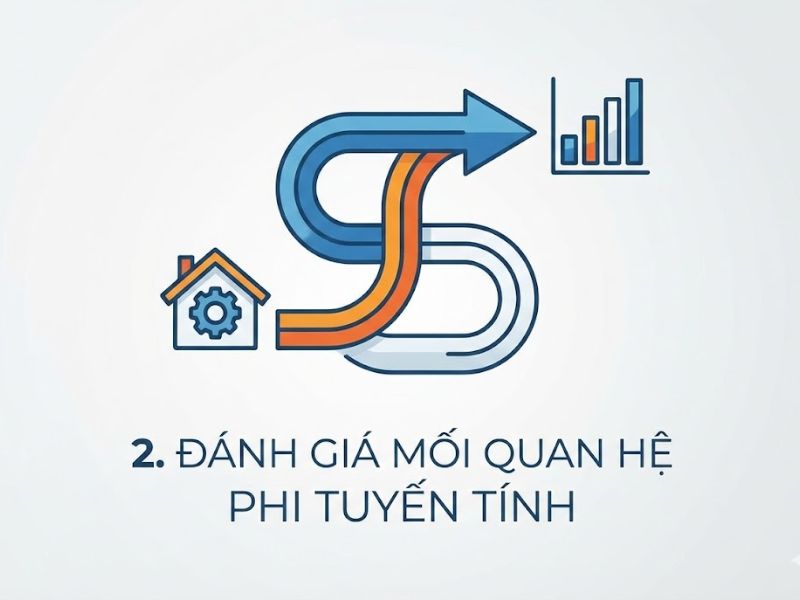
2. Đánh giá các mối quan hệ phi tuyến tính trong nghiên cứu doanh nghiệp gia đình
Để làm rõ bức tranh học thuật, các tác giả đã tiến hành đánh giá hệ thống và thu được mẫu gồm 89 bài báo phân tích mối quan hệ phi tuyến tính tính đến tháng 12/2020.
Các kết quả đánh giá nổi bật bao gồm:
- Sự gia tăng mạnh mẽ: Số lượng bài báo sử dụng mối quan hệ phi tuyến tính tăng vọt, chiếm 85,4% (76/89 bài) chỉ trong 10 năm qua.
- Phương pháp phổ biến nhất: 93,3% (83/89 bài) sử dụng số hạng bậc hai (quadratic term) để tạo ra các mối quan hệ hình chữ U hoặc chữ U ngược. Chỉ có 5,62% (5/89 bài) cân nhắc số hạng bậc ba.
- Sự thống trị của biến nhân khẩu học: Các nhà nghiên cứu tập trung chủ yếu vào biến nhân khẩu học như sở hữu (ownership), quản lý (management) và quản trị (governance) làm đại diện cho tác động gia đình.
- Bỏ qua biến tiềm ẩn: Chỉ có 4,49% (4/89 bài) thực sự xem xét các biến tiềm ẩn trong mô hình phi tuyến của họ.
Tổng kết lại, lĩnh vực này tồn tại 4 hạn chế phương pháp luận:
- Sử dụng quá mức các biến nhân khẩu học làm đại diện cho hành vi.
- Thiếu việc sử dụng các biến tiềm ẩn để nắm bắt bản chất hành vi.
- Xu hướng dùng điểm tổng cộng gán trọng số bằng nhau cho mọi chỉ báo.
- Thiếu các phân tích sau ước lượng để xác nhận mức độ liên quan thực tiễn.
3. Khái Niệm Hóa và Cấu Trúc Khái Niệm (Conceptualization)
- Mối quan hệ phi tuyến tính (Nonlinear relationships): Là dạng liên kết mà sự thay đổi của biến độc lập không tạo ra sự thay đổi theo tỷ lệ cố định ở biến phụ thuộc. Nó được biểu diễn qua đa thức bậc hai (quadratic effects), trong đó biến độc lập tự tương tác với chính nó (Y₂²). Phương trình có dạng: Y₁ = p₁Y₂ + p₂Y₂² + e₁.
- Biến tiềm ẩn (Latent Variables): Là các khái niệm trừu tượng (như SEW, mục tiêu gia đình) không thể đo lường trực tiếp mà phải dùng thang đo đa biến (multi-item scales). PLS-SEM đo lường các biến này dưới dạng các biến tổng hợp (composites).

4. Quy Trình Phát Triển Phương Pháp & Thang Đo (Methodological & Scale Process)
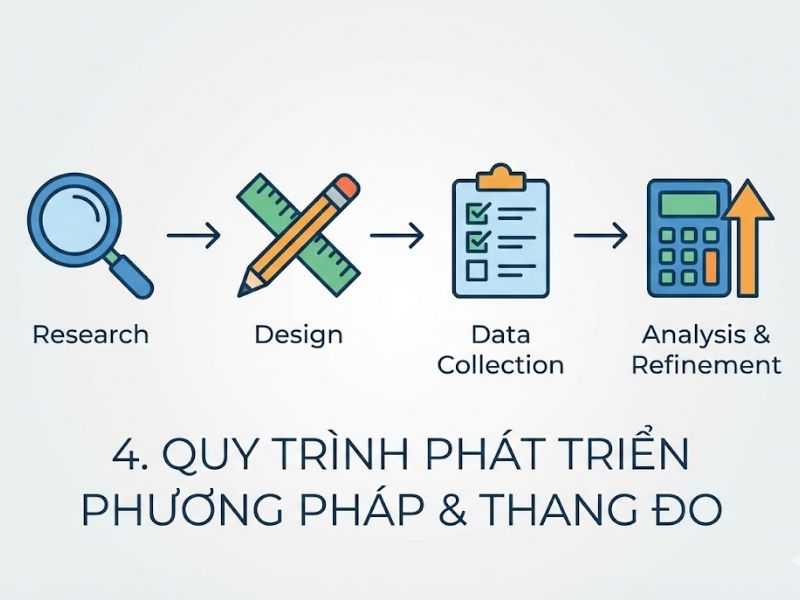
Để đo lường mối quan hệ phi tuyến tính trong PLS-SEM, nghiên cứu chỉ ra rằng Cách tiếp cận hai giai đoạn (Two-stage approach) là phù hợp nhất:
- Giai đoạn 1: Ước lượng mô hình cơ bản để lấy điểm số cấu trúc (construct scores) cho biến phụ thuộc Y₁ và biến độc lập Y₂.
- Giai đoạn 2: Sử dụng điểm số cấu trúc để tính toán biến tương tác bậc hai (Y₂²) và đưa vào mô hình như một biến đơn chỉ báo (single-item construct) để tính toán kết quả cuối cùng.
Phương pháp này giúp giảm thiểu sai số đo lường so với hồi quy điểm tổng vì PLS-SEM tính toán trọng số chỉ báo dựa trên khả năng giải thích trong mô hình.
5. Thang Đo Lường Chính Thức (Measurement Scale)
Bài báo sử dụng bộ dữ liệu từ 567 doanh nghiệp gia đình Tây Ban Nha (Basco, 2013). Kết quả đánh giá chất lượng thang đo (Bảng A2):
| Khái niệm cấu trúc (Construct) | Cronbach’s alpha | ρA | ρc | AVE |
| Ra quyết định hướng về gia đình | 0.877 | 0.893 | 0.914 | 0.639 |
| Hiệu suất kinh tế doanh nghiệp | 0.722 | 0.835 | 0.881 | 0.649 |
| Hiệu suất kinh tế gia đình | 0.711 | 0.729 | 0.821 | 0.535 |
(Ghi chú: Toàn bộ các chỉ số đều đạt chuẩn: Cronbach’s alpha, ρA, ρc > 0.7 và AVE > 0.5 ).
Giá trị phân biệt (Discriminant Validity) được xác nhận qua tỷ số HTMT thấp hơn ngưỡng 0.85 (Bảng A3).
6. Mạng Lưới Quan Hệ Lý Thuyết (Nomological Network)
Mô hình nghiên cứu (Hình 2) có cấu trúc như sau:
- Tiền tố (Antecedents): Sự tham gia quản lý của gia đình (Family management involvement).
- Biến trung gian: Ra quyết định chiến lược hướng về gia đình (Family-oriented strategic decision making).
- Hậu tố (Consequences): Nghiên cứu mở rộng kiểm định tác động phi tuyến bậc hai lên Hiệu suất kinh tế gia đình và doanh nghiệp.
Kết quả thực nghiệm cho thấy biến tương tác bậc hai có tác động tích cực đáng kể (p < 0.05), xác nhận mối quan hệ hàm lồi (convex function), nghĩa là hiệu suất tăng tốc khi việc ra quyết định hướng về gia đình đạt mức cao.
7. Hướng Dẫn Ứng Dụng Nghiên Cứu (Academic Implications)
Checklist chuẩn cho nhà nghiên cứu khi sử dụng PLS-SEM để kiểm định phi tuyến tính:
- Lập luận lý thuyết: Thiết lập kỳ vọng phi tuyến tính a priori.
- Dữ liệu: Sử dụng dữ liệu chuẩn hóa (standardized data) để tạo biến bậc hai.
- Bootstrapping: Chạy 10.000 mẫu con, dùng khoảng tin cậy 95% (percentile approach) để kiểm định ý nghĩa.
- Đánh giá mức độ phù hợp: Kiểm tra quy mô tác động f² (các mốc 0.005, 0.01 và 0.025 cho mức nhỏ, trung bình, lớn). Sử dụng tiêu chí BIC để so sánh mô hình phi tuyến với mô hình tuyến tính.
8. Ứng Dụng Quản Trị Doanh Nghiệp (Managerial Implications)
- Nhận diện ngưỡng tới hạn (Thresholds): Giúp nhà quản trị biết khi nào một yếu tố tích cực (như sự gắn bó cảm xúc) có thể biến thành tiêu cực nếu vượt quá ngưỡng (too-much-of-a-good-thing effect).
- Tư duy Ambidextrous: Khuyến khích doanh nghiệp gia đình cân bằng đồng thời nhu cầu gia đình và doanh nghiệp (“both/and”) thay vì chỉ chọn một trong hai.
9. Các Câu Hỏi Thường Gặp (FAQ)
Tại sao nên dùng PLS-SEM thay vì Hồi quy điểm tổng?
Hồi quy điểm tổng bỏ qua sai số đo lường, dẫn đến kết quả sai lệch. PLS-SEM tính toán trọng số chỉ báo riêng biệt và giảm thiểu sai số, mang lại kết quả chính xác hơn cho các mô hình phức tạp.
Hiệu ứng bậc hai (Quadratic effect) khác gì biến điều tiết?
Hiệu ứng bậc hai là một trường hợp đặc biệt của phân tích điều tiết, trong đó biến độc lập tự điều tiết (self-moderates) chính nó. Kích thước tác động thay đổi tùy thuộc vào chính giá trị của biến đó.
Làm sao biết mô hình phi tuyến có thực sự tốt hơn mô hình tuyến tính?
Bạn cần đối chiếu chỉ số BIC. Mô hình có giá trị BIC thấp hơn được coi là cân bằng tốt hơn giữa độ phức tạp và độ phù hợp dữ liệu.
10. Tài Liệu Tham Khảo (References)
Abbasi, G. A., Tiew, L. Y., Tang, J., Goh, Y. N., & Thurasamy, R. (2021). The adoption of cryptocurrency as a disruptive force: Deep learning-based dual stage structural equation modelling and artificial neural network analysis. PLoS ONE, 16(3), Article e0247582.
Aguinis, H., Beaty, J., Boik, R., & Pierce, C. (2005). Effect size and power in assessing moderating effects of categorical variables using multiple regression: A 30-Year Review. The Journal of Applied Psychology, 90, 94-107.
Albers, S. (2010). PLS and success factor studies in marketing. In V. Esposito Vinzi, W. W. Chin, J. Henseler, & H. Wang (Eds.), Handbook of partial least squares (pp. 409-425). Berlin-Heidelberg: Springer.
Barros-Contreras, I., Basco, R., Martín-Cruz, N., & Hernangómez, J. (2021). Strategic management in family business. The missing concept of the familiness learning mechanism. Journal of Family Business Management. Online first.
Basco, R. (2013). The family’s effect on family firm performance: A model testing the demographic and essence approaches. Journal of Family Business Strategy, 4(1), 42-66.
Basco, R. (2017). “Where do you want to take your family firm?” A theoretical and empirical exploratory study of family business goals. BRQ Business Research Quarterly, 20(1), 28-44.
Basco, R., Campopiano, G., Calabrò, A., & Kraus, S. (2019). They are not all the same! Investigating the effect of executive versus non-executive family board members on firm performance. Journal of Small Business Management, 57(2), 637-657.
Basco, R., & Voordeckers, W. (2015). The relationship between the board of directors and firm performance in private family firms. A test of the demographic versus behavioral approach. Journal of Management & Organization, 21(4), 411-435.
Bauweraerts, J., & Colot, O. (2017). Exploring nonlinear effects of family involvement in the board on entrepreneurial orientation. Journal of Business Research, 70, 185-192.
Becker, J.-M., Ringle, C., & Sarstedt, M. (2018). Estimating Moderating Effects in PLS-SEM and PLSc-SEM: Interaction Term Generation Data Treatment. Journal of Applied Structural Equation Modeling, 2(2), 1-21.
Berrone, P., Cruz, C., & Gomez-Mejia, L. R. (2012). Socioemotional wealth in family firms: Theoretical dimensions, assessment approaches, and agenda for future research. Family Business Review, 25(3), 258-279.
Bilger, M., & Manning, W. G. (2015). Measuring overfitting in nonlinear models: A new method and an application to health expenditures. Health Economics, 24(1), 75-85.
Binz Astrachan, C., Patel, V. K., & Wanzenried, G. (2014). A comparative study of CB-SEM and PLS-SEM for theory development in family firm research. Journal of Family Business Strategy, 5(1), 116-128.
Boling, J. R., Pieper, T. M., & Covin, J. G. (2016). CEO tenure and entrepreneurial orientation within family and nonfamily firms. Entrepreneurship Theory and Practice, 40(4), 891-913.
Burnham, K. P., & Anderson, D. R. (2002). Model selection and multimodel inference: A Practical Information-theoretic Approach. Heidelberg: Springer.
Cabeza-García, L., Sacristán-Navarro, M., & Gómez-Ansón, S. (2017). Family involvement and corporate social responsibility disclosure. Journal of Family Business Strategy, 8(2), 109-122.
Calabrò, A., Campopiano, G., & Basco, R. (2017). Principal-principal conflicts and family firm growth: The moderating role of business family identity. Journal of Family Business Management, 7(3), 291-308.
Carr, J. C., Cole, M. S., Ring, J. K., & Blettner, D. P. (2011). A measure of variations in internal social capital among family firms. Entrepreneurship Theory and Practice, 35(6), 1207-1227.
Chin, W. W., Marcolin, B. L., & Newsted, P. R. (2003). A partial least squares latent variable modeling approach for measuring interaction effects: Results from a Monte Carlo simulation study and an electronic-mail emotion/adoption study. Information Systems Research, 14(2), 189-217.
Cho, J., Miller, D., & Lee, J. (2018). Too much of a good thing: Family involvement and the survival of listed Korean firms. Journal of Family Business Strategy, 9(4), 223-237.
Chua, J. H., Chrisman, J. J., & Sharma, P. (1999). Defining the family business by behavior. Entrepreneurship: Theory & Practice, 23(4), 19-39.
Cole, D. A., & Preacher, K. J. (2014). Manifest variable path analysis: Potentially serious and misleading consequences due to uncorrected measurement error. Psychological Methods, 19(2), 300-315.
Cook, R. D., & Forzani, L. (2020). Fundamentals of path analysis in the social sciences. Retrieved fromhttps://arxiv.org/pdf/2011.06436.pdf.
Danks, N. P., Sharma, P. N., & Sarstedt, M. (2020). Model selection uncertainty and multimodel inference in partial least squares structural equation modeling (PLS-SEM). Journal of Business Research, 113, 13-24.
Duréndez, A., & Madrid-Guijarro, A. (2018). The impact of family influence on financial reporting quality in small and medium family firms. Journal of Family Business Strategy, 9(3), 205-218.
Elsbach, K. D., & Pieper, T. M. (2019). How psychological needs motivate family firm identifications and identifiers: A framework and future research agenda. Journal of Family Business Strategy, 10(3), 10289.
Ferramosca, S., & Allegrini, M. (2018). The complex role of family involvement in earnings management. Journal of Family Business Strategy, 9(2), 128-141.
Frank, H., Kessler, A., Rusch, T., Suess-Reyes, J., & Weismeier-Sammer, D. (2017). Capturing the familiness of family businesses: Development of the family influence familiness scale (FIFS). Entrepreneurship Theory and Practice, 41(5), 709-742.
Frank, H., Suess-Reyes, J., Fuetsch, E., & Kessler, A. (2019). Introducing the enterpriseness of business families. A research agenda. In E. Memili, & C. Dibrell (Eds.), The Palgrave handbook of heterogeneity among family firms (pp. 263-296). Cham: Springer.
Franke, G., & Sarstedt, M. (2019). Heuristics versus statistics in discriminant validity testing: a comparison of four procedures. Internet Research, 29(3), 430-447.
Geweke, J., & Meese, R. (1981). Estimating regression models of finite but unknown order. International Economic Review, 22(1), 55-70.
Grant, A. M., & Schwartz, B. (2011). Too much of a good thing: The challenge and opportunity of the inverted U. Perspectives on Psychological Science, 6(1), 61-76.
Green, S. B., Thompson, M. S., & Babyak, M. A. (1998). A Monte Carlo investigation of methods for controlling type I errors with specification searches in structural equation modeling. Multivariate Behavioral Research, 33(3), 365-383.
Hair, J. F., Astrachan, C. B., Moisescu, O. I., Radomir, L., Sarstedt, M., Vaithilingam, S., et al. (2020). Executing and interpreting applications of PLS-SEM: Updates for family business researchers. Journal of Family Business Strategy, Article 100392. In press.
Hair, J. F., Howard, M. C., & Nitzl, C. (2020). Assessing measurement model quality in PLS-SEM using confirmatory composite analysis. Journal of Business Research, 109, 101-110.
Hair, J. F., Hult, G. T. M., Ringle, C. M., Sarstedt, M., & Thiele, K. O. (2017). Mirror, mirror on the wall: a comparative evaluation of composite-based structural equation modeling methods. Journal of the Academy of Marketing Science, 45(5), 616-632.
Hair, J. F., Hult, T., Ringle, C., & Sarstedt, M. (2022). A primer on partial least squares structural equation modeling (PLS-SEM) (3rd ed.). Thousand Oaks, CA: Sage.
Hair, J. F., Risher, J. J., Sarstedt, M., & Ringle, C. M. (2019). When to use and how to report the results of PLS-SEM. European Business Review, 31(1), 2-24.
Hair, J. F., & Sarstedt, M. (2021). Explanation Plus Prediction: The Logical Focus of Project Management Research. Project Management Journal, 52(4), 319-322.
Hair, J. F., Sarstedt, M., Pieper, T. M., & Ringle, C. M. (2012). The use of partial least squares structural equation modeling in strategic management research: A review of past practices and recommendations for future applications. Long Range Planning, 45(5-6), 320-340.
Hair, J. F., Sarstedt, M., Ringle, C. M., & Gudergan, S. P. (2018). Advanced issues in partial least squares structural equation modeling (PLS SEM). Thousand Oaks, CA: Sage.
Hatak, L., Kautonen, T., Fink, M., & Kansikas, J. (2016). Innovativeness and family-firm performance: The moderating effect of family commitment. Technological Forecasting and Social Change, 102, 120-131.
Hayes, A. F. (2015). An index and test of linear moderated mediation. Multivariate Behavioral Research, 50(1), 1-22.
Hayward, M., Hunt, R., & Miller, D. (2021). How vulnerability enriches family firm relationships: A social exchange perspective. Journal of Family Business Strategy, Article 100450. In press.
Henseler, J., Dijkstra, T. K., Sarstedt, M., Ringle, C. M., Diamantopoulos, A., Straub, D. W., Ketchen, D. J., Hair, J. F., Hult, G. T. M., & Calantone, R. J. (2014). Common beliefs and reality about PLS: Comments on Rönkkö & Evermann (2013). Organizational Research Methods, 17(2), 182-209.
Henseler, J., Ringle, C. M., & Sarstedt, M. (2015). A new criterion for assessing discriminant validity in variance-based structural equation modeling. Journal of the Academy of Marketing Science, 43(1), 115-135.
Hernández-Perlines, F., Moreno-García, J., & Yáñez-Araque, B. (2019). The influence of socioemotional wealth in the entrepreneurial orientation of family businesses. International Entrepreneurship and Management Journal, 15(2), 523-544.
Herrero, I., & Hughes, M. (2019). When family social capital is too much of a good thing. Journal of Family Business Strategy, 10(3), Article 100271.
Hoover, K. D., & Perez, S. J. (1999). Data mining reconsidered: encompassing and the general-to-specific approach to specification search. The Econometrics Journal, 2(2), 167-191.
Hwang, H., & Cho, G. (2020). Global least squares path modeling: A full-information alternative to partial least squares path modeling. Psychometrika, 85(4), 947-972.
Ingram, A. E., Lewis, M. W., Barton, S., & Gartner, W. B. (2016). Paradoxes and innovation in family firms: The role of paradoxical thinking. Entrepreneurship Theory and Practice, 40(1), 161-176.
Jöreskog, K. G., & Wold, H. (1982). The ML and PLS techniques for modeling with latent variables: Historical and comparative aspects. In K. G. Jöreskog, & H. Wold (Eds.), Systems under indirect observation, Part I (pp. 263-270). Amsterdam: North-Holland.
Kaplan, A. (1964). The conduct of inquiry: Methodology for behavioral science. San Francisco, CA: Chandler.
Kellermanns, F. W., Eddleston, K. A., & Zellweger, T. M. (2012). Extending the socioemotional wealth perspective: A look at the dark side. Entrepreneurship Theory and Practice, 36(6), 1175-1182.
Kenny, D. A. (2018). Moderation. Retrieved from http://davidakenny.net/cm/moderation.htm.
Kock, N. (2020). WarpPLS user manual: Version 7.0. Laredo, TX: ScriptWarp Systems.
Labaki, R., & D’Allura, G. M. (2021). A governance approach of emotion in family business: Towards a multi-level integrated framework and research agenda. Entrepreneurship Research Journal, 11(3), 119-158.
Li, J. C.-H. (2018). Curvilinear moderation: A more complete examination of moderation effects in behavioral sciences. Frontiers in Applied Mathematics and Statistics, 4(7), 1-11.
Liengaard, B. D., Sharma, P. N., Hult, G. T. M., Jensen, M. B., Sarstedt, M., Hair, J. F., et al. (2021). Prediction: Coveted, yet forsaken? Introducing a cross-validated predictive ability test in partial least squares path modeling. Decision Sciences, 52(2), 362-392.
Lind, J. T., & Mehlum, H. (2010). With or without U? The appropriate test for a U-shaped relationship. Oxford Bulletin of Economics and Statistics, 72(1), 109-118.
Pearson, A. W., & Lumpkin, G. T. (2011). Measurement in family business research. Family Business Review, 24(4), 287-291.
Perez Rodriguez, M. J., & Basco, R. (2011). The cognitive legitimacy of the family business field. Family Business Review, 24(4), 322-342.
Pierce, J. R., & Aguinis, H. (2011). The too-much-of-a-good-thing effect in management. Journal of Management, 39(2), 313-338.
Pittino, D., Chirico, F., Bau, M., Villasana, M., Naranjo-Priego, E. E., & Barron, E. (2020). Starting a family business as a career option: The role of the family household in Mexico. Journal of Family Business Strategy, 11(2), Article 100338.
Praet, A. (2013). Family firms and the divestment decision: An agency perspective. Journal of Family Business Strategy, 4(1), 34-41.
Rasoolimanesh, S. M., Ringle, C. M., Sarstedt, M., & Olya, H. (2021). The combined use of symmetric and asymmetric approaches: partial least squares-structural equation modeling and fuzzy-set qualitative comparative analysis. International Journal of Contemporary Hospitality Management, 33(5), 1571-1592.
Ray, S., Danks, N. P., & Velasquez Estrada, J. M. (2021). R package SEMinR: Domain-specific language for building and estimating structural equation models (version 2.2.0). Retrieved fromhttps://cran.r-project.org/web/packages/seminr/.
Rhemtulla, M., van Bork, R., & Borsboom, D. (2020). Worse than measurement error: Consequences of inappropriate latent variable measurement models. Psychological Methods, 25(1), 30-45.
Richter, N. F., Schubring, S., Hauff, S., Ringle, C. M., & Sarstedt, M. (2020). When predictors of outcomes are necessary: guidelines for the combined use of PLS-SEM and NCA. Industrial Management & Data Systems, 120(12), 2243-2267.
Rigdon, E. E., Ringle, C. M., & Sarstedt, M. (2010). Structural modeling of heterogeneous data with partial least squares. In N. K. Malhotra (Ed.), Review of Marketing Research (pp. 255-296). Armonk, NY: Sharpe.
Rigdon, E. E., Sarstedt, M., & Ringle, C. (2017). On comparing results from CB-SEM and PLS-SEM: Five perspectives and five recommendations. Marketing ZFP, 39, 4-16.
Ringle, C. M., Wende, S., & Becker, J.-M. (2015). SmartPLS 3. Boenningstedt: SmartPLS. Retrieved fromhttps://www.smartpls.com.
Rousseau, M. B., Kellermanns, F., Zellweger, T., & Beck, T. E. (2018). Relationship conflict, family name congruence, and socioemotional wealth in family firms. Family Business Review, 31(4), 397-416.
Santiago, A., Pandey, S., & Manalac, M. T. (2019). Family presence, family firm reputation and perceived financial performance: Empirical evidence from the Philippines. Journal of Family Business Strategy, 10(1), 49-56.
Sarstedt, M., & Danks, N. P. (2021). Prediction in HRM research: A gap between rhetoric and reality. Human Resource Management Journal. In press.
Sarstedt, M., Hair, J. F., Nitzl, C., Ringle, C. M., & Howard, M. C. (2020). Beyond a tandem analysis of SEM and PROCESS: Use of PLS-SEM for mediation analyses! International Journal of Market Research, 62(3), 288-299.
Sarstedt, M., Hair, J. F., Ringle, C. M., Thiele, K. O., & Gudergan, S. P. (2016). Estimation issues with PLS and CBSEM: Where the bias lies! Journal of Business Research, 69(10), 3998-4010.
Sarstedt, M., & Mooi, E. A. (2019). A concise guide to market research: The process, data, and methods using IBM SPSS statistics (3rd ed.). Berlin: Springer.
Sarstedt, M., Ringle, C. M., Cheah, J.-H., Ting, H., Moisescu, O. I., & Radomir, L. (2019). Structural model robustness checks in PLS-SEM. Tourism Economics, 26(4), 531-554.
Sarstedt, M., Ringle, C. M., & Hair, J. F. (2017). Partial least squares structural equation modeling. In C. Homburg, M. Klarmann, & A. Vomberg (Eds.), Handbook of market research (pp. 1-40). Springer.
Sarstedt, M., Ringle, C. M., Smith, D., Reams, R., & Hair, J. F. (2014). Partial least squares structural equation modeling (PLS-SEM): A useful tool for family business researchers. Journal of Family Business Strategy, 5(1), 105-115.
Schwarz, G. (1978). Estimating the dimension of a model. The Annals of Statistics, 6(2), 461-464.
Sciascia, S., Mazzola, P., Astrachan, J., & Pieper, T. (2012). The role of family ownership in international entrepreneurship: exploring nonlinear effects. Small Business Economics, 38(1), 15-31.
Sharma, A., Dwivedi, Y. K., Arya, V., & Siddiqui, M. Q. (2021). Does SMS advertising still have relevance to increase consumer purchase intention? A hybrid PLS-SEM-neural network modelling approach. Computers in Human Behavior, 124, Article 106919.
Sharma, P. N., Sarstedt, M., Shmueli, G., Kim, K., & Thiele, K. (2019). PLS-based model selection: The role of alternative explanations in information systems research. Journal of the Association for Information Systems, 20(4), 346-397.
Sharma, P. N., Shmueli, G., Sarstedt, M., Danks, N., & Ray, S. (2018). Prediction-oriented model selection in partial least squares path modeling. Decision Sciences, 52(3), 567-607.
Shmueli, G., Ray, S., Velasquez Estrada, J. M., & Chatla, S. B. (2016). The elephant in the room: Predictive performance of PLS models. Journal of Business Research, 69(10), 4552-4564.
Shmueli, G., Sarstedt, M., Hair, J. F., Cheah, J.-H., Ting, H., Vaithilingam, S., et al. (2019). Predictive model assessment in PLS-SEM: guidelines for using PLSpredict. European Journal of Marketing, 53(11), 2322-2347.
Sohaib, O., Hussain, W., Asif, M., Ahmad, M., & Mazzara, M. (2020). A PLS-SEM neural network approach for understanding cryptocurrency adoption. IEEE Access, 8, 13138-13150.
Streukens, S., & Leroi-Werelds, S. (2016). Bootstrapping and PLS-SEM: A step-by-step guide to get more out of your bootstrap results. European Management Journal, 34(6), 618-632.
Tenenhaus, M. (2008). Component-based structural equation modelling. Total Quality Management & Business Excellence, 19(7-8), 871-886.
Thornton, P. H., Ocasio, W., & Lounsbury, M. (2012). The institutional logics perspective: A new approach to culture, structure, and process. Oxford: Oxford Scholarship Online.
Williams, R. I., Jr, Pieper, T. M., Kellermanns, F. W., & Astrachan, J. H. (2018). Family firm goals and their effects on strategy, family and organization behavior: A review and research agenda. International Journal of Management Reviews, 20(S1), S63-S82.
Williams, R. I., Pieper, T. M., Kellermanns, F. W., & Astrachan, J. H. (2019). Family business goal formation: a literature review and discussion of alternative algorithms. Management Review Quarterly, 69(3), 329-349.
Wilson, S. R., Whitmoyer, J. G., Pieper, T. M., Astrachan, J. H., Hair, J. F., Jr, & Sarstedt, M. (2014). Method trends and method needs: Examining methods needed for accelerating the field. Journal of Family Business Strategy, 5(1), 4-14.
Wold, H. (1982). Soft Modeling: The basic design and some extensions. In K. G. Jöreskog, & H. Wold (Eds.), Systems under indirect observations: Part II (pp. 1-54). Amsterdam: North-Holland.
Yuan, K.-H., Wen, Y., & Tang, J. (2020). Regression analysis with latent variables by partial least squares and four other composite scores: Consistency, bias and correction. Structural Equation Modeling: A Multidisciplinary Journal, 27(3), 333-350.
Zellweger, T. (2014). Toward a paradox perspective of family firms: The moderating role of collective mindfulness in controlling families. In L. Melin, M. Nordqvist, & P. Sharma (Eds.), The SAGE handbook of family business. London: Sage.
11. Lời kêu gọi hành động (CTA)
Việc am hiểu và ứng dụng chính xác mô hình hóa mối quan hệ phi tuyến tính sẽ nâng tầm độ tin cậy cho nghiên cứu của bạn. Thay vì chỉ đưa ra những kết luận tuyến tính đơn giản, hãy sử dụng PLS-SEM để khai phá những ngưỡng tác động phức tạp của thực tiễn doanh nghiệp.
Để nghiên cứu sâu hơn về phương pháp luận và các bảng dữ liệu chi tiết, bạn có thể tham khảo bài báo gốc tại đây: