The relationship between AI capability and dynamic capabilities explains how organizations convert investments in artificial intelligence into long-term strategic adaptability and competitive advantage. While many firms acquire machine learning software, big data infrastructure, and predictive algorithms, technology alone remains a static asset unless it is integrated into organizational routines. Dynamic capabilities represent a firm’s ability to sense market shifts, seize emerging opportunities, and reconfigure internal competencies in volatile environments. Understanding how tangible, human, and intangible AI resources connect to these three dynamic processes allows researchers to model how digital investments drive innovation, resilience, and firm performance.
Conceptualizing Artificial Intelligence Capability Beyond Technological Assets
To analyze the relationship between AI capability and dynamic capabilities with theoretical precision, scholars must first distinguish between standalone technological tools and firm-level organizational capability. Drawing upon foundational information systems scholarship (Mikalef & Gupta, 2021) and the synthesis of 35 empirical investigations by Nguyen et al. (2026), artificial intelligence capability (AIC) is defined as an organization’s ability to combine, orchestrate, and deploy AI-related technological, human, and intangible resources to generate business value and support strategic adaptation. Rather than treating AI as an off-the-shelf software package, this capability perspective highlights three interdependent resource dimensions:
- Tangible AI Infrastructure: Data lakes, cloud computing architectures, real-time sensor networks, and algorithmic processing pipelines that supply the computational power required for automated pattern recognition, forecasting, and optimization.
- AI-Specific Human Competencies: Both technical skills (data engineering, algorithm training, system integration, and model calibration) and managerial skills (the capacity of leaders to interpret algorithmic outputs, align AI initiatives with corporate strategy, and coordinate human-machine collaboration).
- Intangible Organizational Assets: A data-driven organizational culture, cross-functional knowledge-sharing routines, organizational change readiness, and ethical governance structures that allow AI insights to be assimilated into daily operational and strategic workflows (Fosso Wamba et al., 2024; Al Halbusi, Popa, Soto-Acosta, & Abdelallag, 2025).
In their systematic review, Nguyen et al. (2026) note that the empirical literature employs several closely related terms-including AI capability, AI-enabled capability, AI-based capability, and artificial intelligence competence-to capture this construct. Furthermore, recent empirical work has expanded the scope of AI capability beyond traditional descriptive, predictive, and prescriptive analytics (Chen, Li, Tang, Li, & Guo, 2026) to encompass generative AI capability and large language model (LLM) work integration, where firms leverage generative architectures to accelerate ideation, service innovation, and knowledge orchestration (Li, Xu, Zhang, Liu, & Li, 2025; Al-Khatib, Al-Fadhel, & Khattab, 2026; Liu et al., 2026). Across these sub-streams, the defining characteristic of AI capability is resource complementarity: hardware and algorithms remain inert unless paired with skilled human judgment and adaptive organizational processes.
Theoretical Foundations: How AI Capability Interacts with Dynamic Capabilities
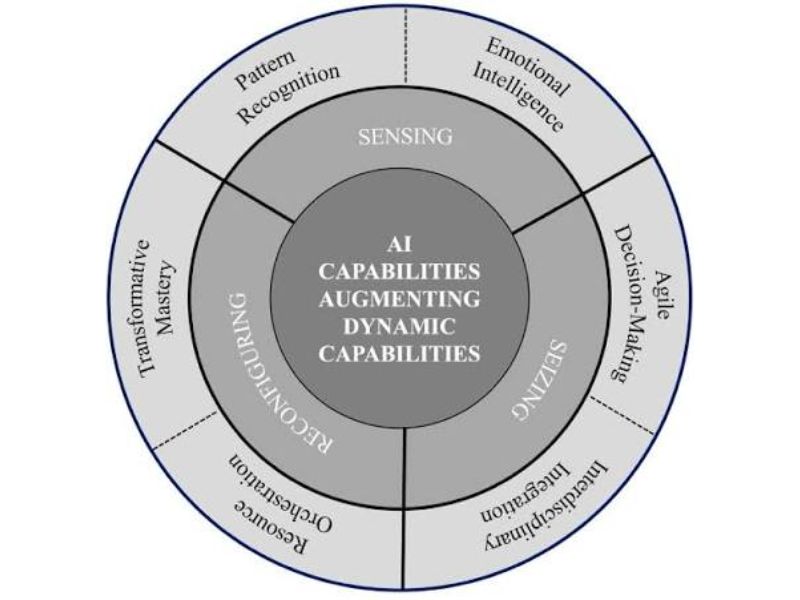
In external foundational strategy literature, the Resource-Based View (RBV) posits that firms achieve competitive advantage by controlling valuable, rare, inimitable, and non-substitutable (VRIN) resources (Barney, 1991). However, because static resource bundles can quickly become obsolete in turbulent markets, Dynamic Capabilities Theory (DCT) extends RBV by explaining how firms continuously integrate, build, and reconfigure internal and external competencies through three microfoundations: sensing, seizing, and reconfiguring (Teece et al., 1997; Teece, 2007). In examining the relationship between AI capability and dynamic capabilities across the 35 empirical studies, Nguyen et al. (2026) show how AI capability supports each of these microfoundations while also surfacing an important theoretical debate regarding its exact structural role.
AI Capability in Sensing Opportunities and Threats
Sensing comprises organizational processes for scanning external environments, interpreting market signals, tracking competitor actions, and identifying emerging customer needs or supply chain risks. Empirical studies reviewed by Nguyen et al. (2026) demonstrate that AI capability strengthens sensing by automating the extraction of patterns from massive, high-velocity datasets (Chen et al., 2026; Wang & Zhang, 2026). Through predictive modeling and automated anomaly detection, AI-enabled sensing allows firms to anticipate demand shifts, monitor regulatory and environmental sustainability indicators, and detect geopolitical or supply chain disruptions before they escalate into operational crises (Camargo, Morales, Nascimento, & Tortorella, 2025; AlQershi, Ramayah, Alzuraiki, & Emam, 2026).
AI Capability in Seizing Strategic Opportunities
Once environmental opportunities or threats are sensed, seizing involves mobilizing resources, making timely strategic decisions, and designing new products, services, or business models to capture value. Within the empirical corpus synthesized by Nguyen et al. (2026), AI capability reinforces seizing through AI-augmented decision-making, scenario simulation, and prescriptive analytics (Kugeza, 2026; Lee, Lee, & Kim, 2026). By expanding organizational information processing capacity and reducing decision latency, AI capability enhances decision-making agility and enables organizations to pursue both exploratory and exploitative innovation-a dual capacity conceptualized under Organizational Ambidexterity Theory (Ahmad, 2025; Kumar, Kumar, Chaudhuri, Chatterjee, & Vrontis, 2025; Al-Khatib et al., 2026).
AI Capability in Reconfiguring Organizational Assets and Routines
Reconfiguring entails transforming, recombining, and realigning tangible and intangible organizational assets to maintain evolutionary fitness as markets and technologies shift (Teece, 2007). Empirical studies in the review show that AI capability facilitates resource orchestration, business model transformation, industrial servitization, and green supply chain realignment (Abou-Foul, Ruiz-Alba, & López-Tenorio, 2023; Duong, 2026; Le, Vu, Phan, & Dao, 2026). Crucially, however, Nguyen et al. (2026) emphasize that scholars conceptualize the position of AI capability within this process in three distinct ways:
- As a Foundational Strategic Resource or Antecedent: Treating AI capability as an organizational input that precedes and enables the development of dynamic capabilities (Abou-Foul et al., 2023; Lu, Fan, Troise, & Bresciani, 2026).
- As a Higher-Order Dynamic Capability: Viewing AI capability itself as a dynamic capability that directly executes sensing, seizing, and reconfiguring functions (Chen et al., 2026; T. L. Le, 2026).
- As a Capability-Enhancing Mechanism (Capability Enhancer): Arguing that AI capability does not operate autonomously as an independent dynamic capability, but instead acts as an amplifying mechanism that augments human-driven sensing, seizing, and reconfiguring routines (Ratanacharooenchai & Jantapoon, 2026; Javed, Švecová, Danko, & Tučková, 2026).
| Dynamic Capability Dimension | Analytical Function of AI Capability | Organizational Mechanisms Identified in Nguyen et al. (2026) | Representative Empirical Studies in the Corpus |
|---|---|---|---|
| Sensing (Scanning & Learning) | Descriptive and predictive analytics; automated pattern recognition; real-time environmental monitoring | Corporate foresight, market signal detection, supply chain visibility, geopolitical risk identification | Camargo et al. (2025); Chen et al. (2026); AlQershi et al. (2026); Wang & Zhang (2026) |
| Seizing (Deciding & Innovating) | Prescriptive analytics; AI-augmented decision-making; generative design and knowledge synthesis | Decision-making agility, innovation ambidexterity, digital product innovation, strategic flexibility | Ahmad (2025); Kugeza (2026); Lee et al. (2026); T. L. Le (2026); Al-Khatib et al. (2026) |
| Reconfiguring (Transforming & Orchestrating) | Automated workflow coordination; resource orchestration; cross-functional system integration | Business model transformation, servitization, supply chain resilience, circular economy reconfiguration | Abou-Foul et al. (2023); Duong (2026); A. D. Le et al. (2026); Lu et al. (2026); Ratanacharooenchai & Jantapoon (2026) |
Empirical Synthesis of Antecedents, Mediators, Moderators, and Outcomes
To provide researchers with a clear nomological network of the relationship between AI capability and dynamic capabilities, Nguyen et al. (2026) analyzed the substantive characteristics of the 35 core empirical studies (Table 5 of the review). Their findings demonstrate that the impact of AI capability on firm performance is highly structured through mediating mechanisms and contingent upon internal and external boundary conditions:
Structural Role of AI Capability in Empirical Models
Among the 35 reviewed studies, 33 investigations model AI capability or AI-related constructs as an antecedent or exogenous predictor, whereas 13 studies examine AI capability as a mediator, moderator, or endogenous capability shaped by upstream organizational factors. When modeled as an endogenous construct, AI capability is driven by antecedents such as green strategic intent (Zahoor et al., 2025), corporate leadership and policy environment (Zhong et al., 2026), multidimensional intellectual capital (Lu et al., 2026), and entrepreneurial orientation (Dubey et al., 2020).
Mediating Dynamic Capability Mechanisms (28 of 35 Studies)
A central empirical finding of Nguyen et al. (2026) is that 28 out of 35 studies incorporate explicit mediating constructs to explain how AI capability translates into organizational outcomes. Rather than exerting a purely direct effect, AI capability operates through four primary families of mediating mechanisms:
- Agility and Adaptive Mechanisms: Organizational agility, decision-making agility, strategic flexibility, and adaptive capability serve as immediate conduits translating algorithmic insights into rapid market responses (Lee et al., 2026; Lu et al., 2026; T. L. Le, 2026; Zhong et al., 2026).
- Resilience Mechanisms: Supply chain resilience, employee resilience, and strategic resilience enable firms to absorb shocks and maintain operational continuity during crises (Ratanacharooenchai & Jantapoon, 2026; Javed et al., 2026; Chowdhury et al., 2026).
- Innovation and Ambidexterity Mechanisms: Innovation ambidexterity, green ambidexterity, open innovation, and business model transformation convert AI resources into novel products, services, and circular business processes (Ahmad, 2025; Duong, 2026; Al-Khatib et al., 2026).
- Knowledge and Resource Orchestration Mechanisms: Absorptive capacity, green knowledge integration, and resource orchestration allow organizations to assimilate AI-generated knowledge across internal and external boundaries (Abou-Foul et al., 2023; Kumar et al., 2025).
Moderating Boundary Conditions (24 of 35 Studies) and Key Outcomes
Twenty-four of the 35 studies examine moderating variables that govern when and how strongly AI capability enhances dynamic capabilities and downstream outcomes. External moderators include environmental dynamism, technological turbulence, market turbulence, and government or regulatory intervention (Dubey et al., 2020; Li et al., 2025; A. D. Le et al., 2026). Internal moderators include absorptive capacity, data-driven culture, green knowledge management, and cybersecurity awareness (Abou-Foul et al., 2023; Kumar et al., 2025; Chowdhury et al., 2026). In terms of dependent variables, the reviewed studies link this nomological network to four major outcome categories: firm performance and competitive advantage (21 studies), innovation, digital transformation, and servitization outcomes (17 studies), sustainability, green economy, and circular economy performance (14 studies), and organizational resilience and strategic adaptation (10 studies).
Empirical Synthesis and Reference Guide for Researchers
For scholars building conceptual models on the relationship between AI capability and dynamic capabilities, empirical evidence establishes a four-stage causal pathway: AI Resources → AI Capability → AI-Enabled Dynamic Capability Mechanisms (Sensing, Seizing, Reconfiguring) → Organizational Outcomes. Rather than modeling a simple direct link between AI adoption and financial return, researchers should account for how human managerial skills and organizational culture translate algorithmic outputs into concrete strategic actions.
Empirical synthesis of 35 core studies in AI capability in dynamic capabilities: A systematic literature review using the TCCM framework by Nguyen, T. P., Tran, D. K., and Nguyen, T. H. H. (2026), published in the Proceedings of the International Conference on Business Sustainability (ICBS 2026) (pp. 357–370), confirms that organizations achieve superior performance when tangible, human, and intangible AI resources are orchestrated into firm-level AI capability that reinforces sensing, seizing, and reconfiguring routines.
Dowload full paper pdf: AI CAPABILITY IN DYNAMIC CAPABILITIES: A SYSTEMATIC LITERATURE REVIEW USING THE TCCM FRAMEWORK
References (APA 7th Edition)
Abou-Foul, M., Ruiz-Alba, J. L., & López-Tenorio, P. J. (2023). The impact of artificial intelligence capabilities on servitization: The moderating role of absorptive capacity-A dynamic capabilities perspective. Journal of Business Research, 157, 113609. https://doi.org/10.1016/j.jbusres.2022.113609
Ahmad, Z. (2025). Unlocking AI capabilities: Exploring strategic fit, innovation ambidexterity, and digital entrepreneurial intent in driving digital transformation. Journal of Management Development, 44(2), 194–218. https://doi.org/10.1108/JMD-06-2024-0197
Al Halbusi, H., Popa, S., Soto-Acosta, P., & Abdelallag, M. (2025). The nexus of managerial and technical AI knowledge, disruptive innovation and the circular economy: The role of organizational change capability and financial resilience. Technology in Society, 82, 102937. https://doi.org/10.1016/j.techsoc.2025.102937
AlQershi, N., Ramayah, T., Alzuraiki, M., & Emam, A. S. M. (2026). Artificial intelligence and strategic resilience in international business: A new theory of multinational adaptation to geopolitical shocks. Review of International Business and Strategy, 36(1), 1–27. https://doi.org/10.1108/RIBS-03-2025-0061
Barney, J. (1991). Firm resources and sustained competitive advantage. Journal of Management, 17(1), 99–120.
Camargo, G. F., Morales, V. M., Nascimento, D. L., & Tortorella, G. L. (2025). Exploring the role of corporate foresight in the coordination between dynamic capabilities and artificial intelligence in green innovation: A multi-continent comparison. IEEE Transactions on Engineering Management, 72, 1–14. https://doi.org/10.1109/TEM.2025.3533456
Chen, X., Li, Y., Tang, G., Li, W., & Guo, Z. (2026). Exploring how artificial intelligence capabilities impact corporate sustainability performance: Insights from Chinese manufacturing firms. Technovation, 151, 103428. https://doi.org/10.1016/j.technovation.2025.103428
Chowdhury, S., Ren, S., & Dey, P. K. (2026). AI assimilation for sustainable and resilient supply chains: Role of green ambidexterity and cybersecurity awareness. Technovation, 153, 103562. https://doi.org/10.1016/j.technovation.2026.103562
Dubey, R., Gunasekaran, A., Childe, S. J., Bryde, D. J., Giannakis, M., Foropon, C., & Hazen, B. T. (2020). Big data analytics and artificial intelligence pathway to operational performance under the effects of entrepreneurial orientation and environmental dynamism: A study of manufacturing organisations. International Journal of Production Economics, 226, 107599. https://doi.org/10.1016/j.ijpe.2019.107599
Duong, C. D. (2026). The green transition journey: How digital platforms and AI capabilities drive green ambidexterity innovation, circular economy, and sustainable performance. World Development Sustainability, 8, 100268. https://doi.org/10.1016/j.wds.2025.100268
Fosso Wamba, S., Queiroz, M. M., Pappas, I. O., & Sullivan, Y. (2024). Artificial intelligence capability and firm performance: A sustainable development perspective by the mediating role of data-driven culture. Information Systems Frontiers, 26(6), 2315–2330. https://doi.org/10.1007/s10796-023-10456-3
Javed, M., Švecová, L., Danko, L., & Tučková, Z. (2026). Harnessing artificial intelligence and employee resilience for enhanced business performance: A resource-based and dynamic capabilities perspective. Human Behavior and Emerging Technologies, 2026, 1701205. https://doi.org/10.1155/hbet/1701205
Kumar, S., Kumar, V., Chaudhuri, R., Chatterjee, S., & Vrontis, D. (2025). AI capability and environmental sustainability performance: Moderating role of green knowledge management. Technology in Society, 81, 102878. https://doi.org/10.1016/j.techsoc.2025.102878
Le, A. D., Vu, N. T., Phan, T. T. H., & Dao, V. T. (2026). AI-enabled business model transformation and entrepreneurial quality: The moderating effect of technological turbulence. Technology in Society, 85, 103062. https://doi.org/10.1016/j.techsoc.2025.103062
Lee, K., Lee, S., & Kim, S. (2026). AI for decision-making: Exploring the linkage from AI capability to firm performance. Aslib Journal of Information Management, 78(3), 512–534. https://doi.org/10.1108/AJIM-04-2025-0241
Lu, J., Fan, L., Troise, C., & Bresciani, S. (2026). Exploring the nexus between artificial intelligence capability, multidimensional intellectual capital, and organizational agility of SMEs. Journal of Innovation & Knowledge, 11(2), 100697. https://doi.org/10.1016/j.jik.2026.100697
Mikalef, P., & Gupta, M. (2021). Artificial intelligence capability: Conceptualization, measurement calibration, and empirical study on its impact on organizational creativity and firm performance. Information & Management, 58(3), 103434. https://doi.org/10.1016/j.im.2021.103434
Moher, D., Liberati, A., Tetzlaff, J., & Altman, D. G. (2009). Preferred reporting items for systematic reviews and meta-analyses: The PRISMA statement. BMJ, 339, b2535. https://doi.org/10.1136/bmj.b2535
Nguyen, T. P., Tran, D. K., & Nguyen, T. H. H. (2026). AI capability in dynamic capabilities: A systematic literature review using the TCCM framework. In Proceedings of the International Conference on Business Sustainability (ICBS 2026) (pp. 357–370). Information and Communications Publishing House. https://www.researchgate.net/publication/416933536_AI_CAPABILITY_IN_DYNAMIC_CAPABILITIES_A_SYSTEMATIC_LITERATURE_REVIEW_USING_THE_TCCM_FRAMEWORK
Paul, J., & Rosado-Serrano, A. (2019). Gradual internationalization vs born-global/international new venture models: A review and research agenda. International Marketing Review, 36(6), 830–858. https://doi.org/10.1108/IMR-10-2018-0280
Ratanacharooenchai, C., & Jantapoon, K. (2026). The mediating role of supply chain resilience in the relationship between AI capabilities and sustainability performance: Evidence from manufacturing SMEs. Sustainable Futures, 11, 101789. https://doi.org/10.1016/j.sftr.2026.101789
Teece, D. J. (2007). Explicating dynamic capabilities: The nature and microfoundations of (sustainable) enterprise performance. Strategic Management Journal, 28(13), 1319–1350. https://doi.org/10.1002/smj.640
Teece, D. J., Pisano, G., & Shuen, A. (1997). Dynamic capabilities and strategic management. Strategic Management Journal, 18(7), 509–533.

Giảng viên Nguyễn Thanh Phương là chuyên gia chuyên sâu về Nghiên cứu khoa học, Ứng dụng AI, Digital Marketing và Quản trị bản thân. Với kinh nghiệm giảng dạy thực chiến, tác giả trực tiếp hướng dẫn ứng dụng phương pháp luận và phân tích dữ liệu chuyên sâu cho người học nên được sinh viên gọi là Thầy giáo quốc dân. Mọi nội dung chia sẻ đều tuân thủ nguyên tắc khách quan, thực chứng và mang giá trị ứng dụng cao, hướng tới mục tiêu cốt lõi: “Làm bạn tốt hơn!